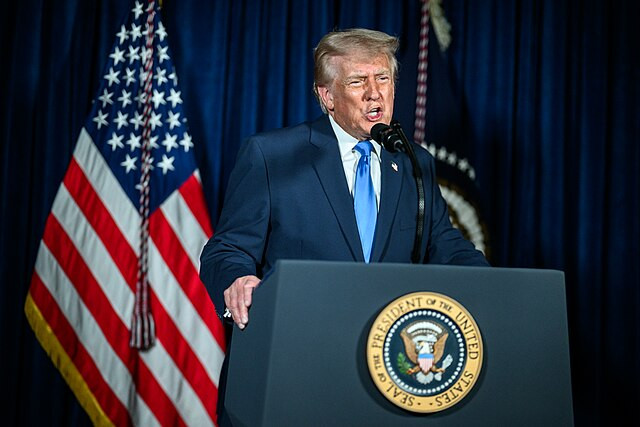
President Donald Trump on Wednesday signaled that the United States could expand its military campaign against Iran, warning that Tehran's failure to reach a negotiated settlement may prompt attacks on critical infrastructure, including power plants and bridges, as tensions continue to rise across the Middle East.
The latest threat came less than 24 hours after U.S. forces launched strikes against Iranian military assets following the downing of an American Apache helicopter near the Strait of Hormuz, a strategic waterway through which a significant share of global oil shipments passes.
According to Fox News correspondent Trey Yingst, Trump indicated that patience inside the White House was wearing thin as negotiations remained stalled. Yingst reported that the president said Iran "had a chance to sign a deal and survive" and was "getting close to ordering new strikes against Iranian power plants and bridges" because he believes the "Iranians are tapping the United States along."
The comments mark one of Trump's strongest warnings since hostilities intensified following the helicopter incident. Earlier this week, the president stated that "the United States must, of necessity, respond to this attack" after asserting that Iranian forces were responsible for bringing down the aircraft near the Strait of Hormuz.
In a separate social media post Wednesday, Trump argued that Tehran had squandered opportunities to end the conflict diplomatically.
"Iran has taken too long to negotiate a deal that would have been great for them," Trump wrote. He also described Iran's military as a "complete and total mess."
"Much of it, like their Navy and Air Force, doesn't even exist anymore - They have been completely defeated. Iran is all talk and no action. The Bully of the Middle East is DEAD!!!" the president added.
The escalation follows a series of military exchanges that have threatened to derail efforts to secure a broader agreement over Iran's nuclear program and regional security issues. Trump has repeatedly claimed in recent weeks that a diplomatic breakthrough was close, at times suggesting a deal could be reached within days. No agreement has yet materialized.
After the Apache helicopter incident, U.S. Central Command launched multiple rounds of strikes targeting Iranian air defense and radar installations near the Strait of Hormuz.
CENTCOM characterized the operation as defensive in nature, stating that "The operation was a proportional response to recent attacks on U.S. forces and international commercial ships transiting regional waters."
Iranian officials responded with warnings of their own. Foreign Minister Abbas Araghchi cautioned that foreign military forces operating near Iranian territory faced growing risks.
"Foreign forces in proximity to our territory are at constant risk," Araghchi said. While emphasizing that Iran preferred diplomacy, he added that the country "speaks other languages too."
In a further warning directed at Washington and its allies, Araghchi declared: "Leave our region if you want to be safe. History of the Persian Gulf has many chapters on dire fates of intruding outsiders."
According to Axios, citing a U.S. official, Iran launched at least four ballistic missiles and several drones targeting regional military facilities. Iranian attacks reportedly focused on bases in Jordan and Kuwait, while Bahraini authorities said their defenses successfully intercepted incoming threats.