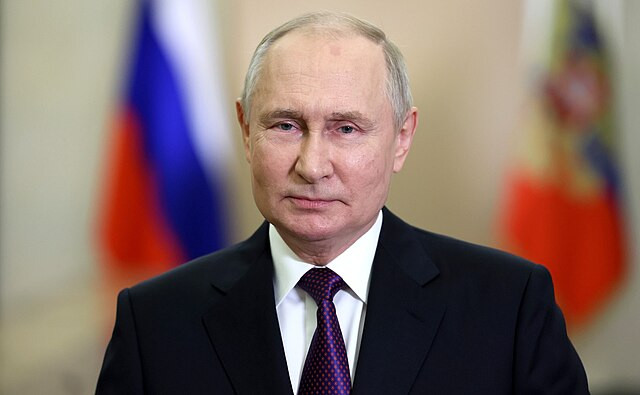
Russian President Vladimir Putin could consider a limited military or cyberattack against a NATO member within the next several years to test whether the alliance would respond collectively, according to a U.S. intelligence assessment reported by The Wall Street Journal, as Washington simultaneously confronts concerns about depleted stocks of some of its most important missiles.
The assessment represents a shift in U.S. intelligence thinking about the risks posed by Russia while its war in Ukraine remains unresolved. Earlier analysis had concluded that Putin was unlikely to deliberately challenge NATO militarily while Russian forces remained heavily committed in Ukraine, according to the Journal.
That calculation began changing earlier this year, the report said, as the Ukraine war settled into a grinding contest in which front lines remained relatively static while Kyiv demonstrated an ability to strike targets deep inside Russia, including infrastructure connected to the country's oil industry.
U.S. intelligence officials assess that a limited attack could be intended less as an attempt to seize substantial NATO territory than as a political and military test of the alliance itself, according to the report. Moscow's objective could be to expose divisions among NATO members over whether and how forcefully they should respond.
The potential window identified in the assessment stretches from this fall through 2029. Intelligence officials reportedly consider such an attack unlikely, but believe the risk could increase over time if Putin fails to achieve strategic gains in Ukraine.
A cyberattack represents another possible method of testing NATO's response without immediately triggering the risks associated with a conventional military assault.
The Defense Department and NATO's Supreme Headquarters Allied Powers Europe didn't comment on the intelligence assessment. NATO spokesman Col. Martin O'Donnell said the alliance routinely prepares for a range of threats.
"We are always thinking through and preparing for any number of scenarios. NATO is watching and we are ready to deter and defend as necessary, which we continue to demonstrate," O'Donnell said.
The assessment comes as the U.S. military faces a separate problem that could complicate preparations for another major conflict: the rapid depletion of missile and air-defense inventories during ongoing operations.
President Donald Trump confronted Defense Secretary Pete Hegseth during a Cabinet meeting at Camp David last week after learning that U.S. missile inventories were considerably lower than he had understood, according to The Washington Post.
Trump questioned why he hadn't received a clearer warning about shortages involving long-range precision weapons and air-defense interceptors, telling Hegseth that he believed the problem "had been fixed," according to people familiar with the discussion cited by the Post.
The scale of weapons consumption illustrates the pressure on U.S. inventories. During the first month of the conflict alone, American forces reportedly used:
- More than 850 Tomahawk cruise missiles
- More than 1,000 Patriot and Terminal High Altitude Area Defense interceptors
- More than 1,300 Army Tactical Missile Systems, or ATACMS
One official describing the ATACMS inventory to The Washington Post said "there's basically none left." Reuters separately reported concerns about the depletion of the missile stockpile.
Those shortages aren't confined to offensive weapons. Heavy use of Patriot and THAAD interceptors has also put pressure on systems that would be crucial for protecting U.S. forces and allies from ballistic and cruise-missile attacks in another conflict.
The ammunition problem has already affected operational planning, according to the Post. One source said inventory concerns contributed to Trump's decision to cancel an operation he subsequently described as "the biggest attack since World War II," while negotiations involving navigation through the Strait of Hormuz continued.