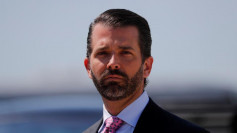
President Donald Trump is facing another round of online speculation about his health after footage showed him repeatedly tapping his right leg while walking toward Air Force One in New Jersey, adding to months of intense scrutiny surrounding the 80-year-old president's movements, hands and public appearances.
The video, recorded as Trump returned to Washington after a weekend at Trump National Bedminster, shows the president crossing the runway in a blue suit and a white-and-gold USA cap. As he walked toward the presidential aircraft, Trump repeatedly moved one hand toward his leg, a gesture that quickly became the focus of social-media commentary.
"What is up with tapping the leg?" one user wrote after the footage circulated on X. Another described Trump as "The walking dead."
Some users went substantially further, attempting to attach a medical explanation to the movement. One commenter characterized the behavior as a "dementia tic," prompting the account that originally shared the footage to reply, "Indeed."
There is no medical evidence presented with the video establishing that Trump's leg-tapping is connected to dementia or any other neurological condition. IBTimes UK said it couldn't independently verify the medical claims circulating online, and diagnosing a condition from a brief video of a public appearance isn't medically reliable.
Other viewers offered less alarming interpretations. The repeated motion could represent anything from a habitual gesture to a self-soothing movement, but no public medical assessment has established why Trump was tapping his leg.
The episode illustrates how closely Trump's physical movements are now being examined as he serves his second term at an age when presidential health inevitably attracts attention. Earlier footage prompted similar commentary after viewers claimed Trump appeared to limp or had difficulty walking in a straight line.
Those observations likewise generated theories about his health without evidence establishing an underlying medical cause.
Attention has also centered repeatedly on Trump's hands. Images released earlier this month appeared to show discoloration, bruising and swelling, leading critics on social media to use increasingly dramatic descriptions of their appearance.
One widely circulated post claimed Trump's hands appeared to be "rotting," while another user compared his fingers to "stuffed sausages." Neither description constituted a medical assessment, although the photographs renewed questions about visible bruising that has appeared in previous public images of the president.
The White House has previously addressed bruising on Trump's hands. Officials have attributed such marks to frequent handshaking and aspirin use rather than an undisclosed serious illness, an explanation given after earlier photographs prompted questions about discoloration.
Trump's appearance has become an unusually persistent subject of online discussion, extending beyond physical movement. His hair, skin tone, weight and use of photographs on social media have repeatedly generated commentary from supporters and critics.
That scrutiny intensified again after Trump posted an apparently AI-enhanced image following a golf event involving nine-time major champion Gary Player and Yasir Al-Rumayyan, governor of Saudi Arabia's Public Investment Fund. Critics seized on the digitally altered appearance of the photograph as another element in the wider discussion about how the president presents himself publicly.
Separate images showing what social-media users described as large bruises and a white mark on Trump's arm have also circulated, producing additional theories about his health. Those claims similarly haven't been accompanied by medical evidence demonstrating that the marks indicate a serious condition.
The latest Air Force One footage therefore offers considerably less certainty than the online reaction surrounding it suggests. The video shows Trump repeatedly touching or tapping his leg while walking toward the aircraft; it doesn't establish why he was doing so or support the specific "dementia tic" diagnosis promoted by some social-media accounts.