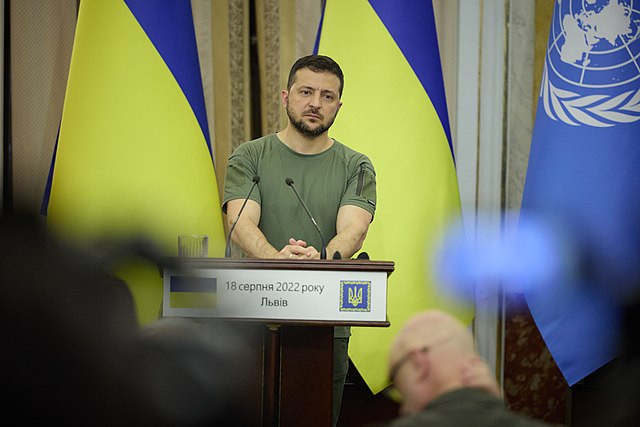
Ukrainian President Volodymyr Zelenskyy warned that Russian President Vladimir Putin is preparing to intensify the war rather than pursue peace, pointing to expanding ballistic-missile production, North Korean military support and preparations for mobilization as Kyiv presses its allies for tougher sanctions and additional air-defense systems.
The warning followed another series of Russian attacks on Ukrainian cities, including Zaporizhzhia, Kyiv, Kherson and Kharkiv. Zelenskyy said six people were killed and 19 wounded in Zaporizhzhia after the city was struck with North Korean missiles, Zircon missiles and guided aerial bombs.
"It was a vicious attack, calculated to inflict maximum damage specifically on civilian infrastructure. Unfortunately, as of now, six people have been reported killed and nineteen wounded in the city," Zelenskyy said in a social-media post Monday night.
In Kyiv, another strike "damaged an infectious diseases hospital building and businesses," Zelenskyy said. Attacks on Kherson and Kharkiv also damaged infrastructure and caused power outages, adding to concerns about Ukraine's ability to protect its electricity system and other essential services.
Zelenskyy presented the attacks as part of a broader Russian military buildup rather than an isolated escalation on the battlefield.
"Every step Russia takes - increasing ballistic missile production, bringing in North Korean equipment, preparing for mobilization - all of this shows that Moscow is preparing not for peace, but for escalation. And the world needs to respond now, not wait," Zelenskyy added.
Kyiv has stepped up its appeals for military assistance in recent days as its stocks of defensive equipment come under pressure. Ballistic-missile interception remains a particular vulnerability because Ukraine has a limited number of systems capable of stopping the weapons.
The North Korean role is also expanding, according to Zelenskyy, who said between 30,000 and 50,000 North Korean troops are being deployed in Russia in connection with the war. Reuters separately reported that North Korea has deployed a ballistic-missile unit in Russia that could be equipped with 120 missiles and six launchers.
The deployment could further complicate Ukraine's air-defense problem if Russia increases the frequency or scale of ballistic attacks. Such missiles are considerably more difficult to intercept than slower-moving drones, making advanced interceptor supplies one of Kyiv's most important requests from Western governments.
The U.S. hasn't recently announced significant new material assistance, but pressure on Moscow is advancing through Congress. The Senate approved a sanctions package championed by the late Sen. Lindsey Graham before his death in July, with 86 senators voting in favor and 11 opposing it.
The legislation would impose tariffs of as much as 100% on countries among the five largest buyers of Russian crude oil or natural gas, potentially bringing major energy customers such as China and India within its reach. The package also targets Putin, Russian oligarchs and financial institutions.
Democratic Sen. Richard Blumenthal described the legislation as an effort to increase the economic cost of continuing the invasion.
"These sledgehammer sanctions and tariffs will stop all who are complicit in this murderous, criminal war of aggression against a brave free people," Blumenthal said, adding that Graham would have been "proud of what we've done."
The legislation now heads to the House, which is in recess until September. Its potential impact would depend heavily on how the tariffs are implemented, particularly because measures aimed at major Russian energy customers could affect U.S. economic relations with China, India and other trading partners.
Zelenskyy's warning comes as Western governments are also assessing the possibility that Russia could eventually expand its confrontation beyond Ukraine. U.S. intelligence officials have assessed that Putin could consider a limited attack on a NATO member in coming years as a way to test the alliance's willingness to defend one of its members, according to The Wall Street Journal.
Earlier U.S. assessments had considered such a move unlikely while Russia remained heavily committed to the war in Ukraine. That view shifted earlier this year as the conflict remained largely deadlocked along the front even as Ukraine demonstrated an ability to strike targets deep inside Russia, including infrastructure connected to its oil industry.
According to the Journal, a limited Russian attack or cyberattack against a NATO country could be intended to fracture the transatlantic alliance by testing whether members would respond collectively. The potential window cited in the assessment stretches from this fall through 2029.