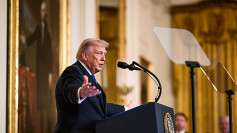
President Donald Trump is signaling that Washington may rely increasingly on economic pressure rather than diplomacy to force concessions from Iran, declaring that the U.S. effectively controls Tehran's access to money as prospects for an agreement between the two countries deteriorate.
Speaking to Real America's Voice, Trump portrayed Iran as financially crippled and argued that U.S. pressure is weakening the country's ability to sustain its government and military. His claims about Iran's inflation, currency and military pay weren't independently substantiated in the material provided.
"They've got 300% inflation. Their currency has almost no value. They're not paying their soldiers. Their soldiers are leaving," Trump said.
While keeping military action available as an option, Trump suggested economic leverage remains his preferred approach. "Economically, they are a mess. They can't borrow money. We control their money, what they had, which is a lot. They had a lot, and we have total control of it. I'm their banker," Trump added.
The comments come as momentum toward an agreement over the Strait of Hormuz appears to have stalled. Senior U.S. officials had expected an agreement to reopen the strategically important waterway last week, but no announcement followed, while Tehran maintained that its negotiations were with Oman rather than Washington.
Trump had already played down the intensity of the diplomatic contacts over the weekend. "We are only semi-negotiating with them. We are just watching Iran with its huge inflation and the fact they have no money," Trump told Axios on Sunday, after saying his administration was "low-keying it."
The dispute widened Monday when Trump said the U.S. would demand compensation from Iran after Tehran advanced its own claims for damages. The competing demands introduce another obstacle into negotiations already complicated by sanctions, military deployments and disagreement over the terms for reopening Hormuz.
Trump said in a social-media post that he was "demanding compensation from Iran, for all of the people that they have killed and gravely wounded with their roadside bombs and many conflicts, for which they are famous, as led initially by General Soleimani, including the families of those killed on the USS Cole, and thousands of others killed in combat."
"Additionally, compensation should be paid to the families of the hundreds of thousands of innocent protestors that Iran has killed over the last 50 years, not to mention the 52,000 that have been killed in the last five months. I have instructed my representatives to put this firmly into any, and all, future negotiations," Trump added.
The president's demand effectively answers Tehran's compensation proposal with a far broader U.S. counterclaim. Iran has called for compensation for damages it attributes to two wars, along with the removal of U.S. sanctions and the release of blocked Iranian assets.
Mohammad Bagher Zolghadr, secretary of Iran's Supreme National Security Council, outlined additional conditions over the weekend for reopening the Strait of Hormuz. Those include an end to what Tehran describes as U.S. aggressive behavior, "including any threats to the country's national and religious sanctities."
Iran is also demanding a permanent end to the "war and aggression against Iran and its allies in Lebanon, Palestine, Yemen and Iraq," according to the conditions outlined by Zolghadr.
Other Iranian demands include lifting the U.S. naval blockade, withdrawing American naval and air forces from Iran's surrounding region and removing what Tehran calls "unjust and illegal" sanctions. Iran also wants the unconditional release of assets it says were "blocked and stolen."
The widening list of demands represents a sharp shift from expectations only days earlier that an agreement over Hormuz could be close. The waterway remains central to the confrontation because of its importance to global energy shipments and the military presence surrounding it.
Iranian Foreign Minister Abbas Araghchi further damped expectations of an immediate breakthrough Sunday, saying there was "no possibility of restarting negotiations" while Washington remained in violation of a memorandum of understanding reached earlier this year.
"Intermediaries are still making efforts to find ways to resume negotiations," Araghchi said.