President Donald Trump ordered the Pentagon to substantially scale back a major U.S.-South Korea military exercise just hours before it was scheduled to begin, arguing that the drills were costly and unnecessarily hostile toward North Korea as he signaled renewed interest in diplomacy with Kim Jong Un.
The decision affects Ulchi Freedom Shield, one of the largest recurring exercises conducted by Washington and Seoul. The roughly 10-day exercise was expected to include about 18,000 South Korean troops, U.S. forces and personnel from 11 member states of the United Nations Command.
Trump said Sunday on Truth Social that the exercises couldn't be canceled entirely because preparations were already too far along. Instead, he directed Defense Secretary Pete Hegseth to sharply reduce their scope, reviving an approach Trump pursued during his first term when he suspended or curtailed exercises as part of his outreach to Pyongyang.
"Based on my very good relationship with Kim Jong Un, of North Korea, I am not happy with the fact that the United States has, long ago, agreed to participate in Joint Military Exercises with South Korea," Trump wrote.
Trump described North Korea as "unthreatening and respectful" during his presidency and said the exercises sent a signal that was "totally inappropriate and hostile." He also complained about the cost to Washington, another argument he repeatedly made about U.S. military commitments in Asia during his first term.
The timing is likely to sharpen debate over military readiness because U.S. and South Korean officials have warned that North Korea is gaining battlefield experience through its involvement in Russia's war against Ukraine. Pyongyang has provided Russia with troops and missiles, exposing its forces to a modern conflict characterized by extensive drone warfare, electronic interference and rapidly evolving battlefield technology.
Ulchi Freedom Shield had been adapted in part to reflect those emerging threats. This year's training was designed to include scenarios involving drones, GPS disruption and cyberattacks-capabilities that have played increasingly prominent roles in the Ukraine war.
North Korea, meanwhile, has continued its own military activity. Days before Trump announced the reduction, Pyongyang launched a ballistic missile toward the sea in what analysts interpreted as another protest against the exercises.
Kim also reaffirmed his relationship with Russian President Vladimir Putin over the weekend, underscoring the increasingly close military relationship between Moscow and Pyongyang. Kim hadn't publicly responded to Trump's decision as of Monday.
Trump's move closely resembles his approach following the 2018 U.S.-North Korea summit in Singapore. After meeting Kim, Trump surprised American allies by describing joint military exercises as "expensive" and "provocative," and his administration subsequently suspended some drills.
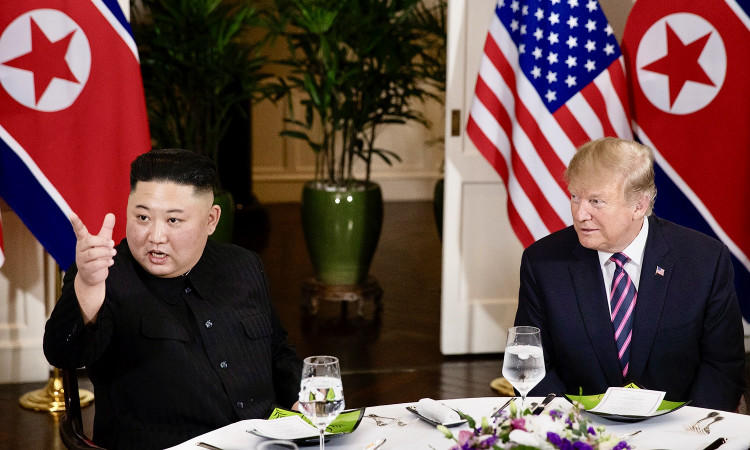
Trump ultimately met Kim three times during his first presidency, including an unprecedented encounter at the Korean Demilitarized Zone. Those meetings produced dramatic diplomatic imagery but didn't result in an agreement requiring North Korea to surrender its nuclear arsenal.
The president has recently begun signaling that he remains interested in restoring the personal diplomacy that characterized those negotiations. Over the weekend, Trump posted an older photograph of himself standing alongside Kim and wrote that the two "get along great," despite their stern expressions in the image.
Trump also linked his dissatisfaction with the exercises to a separate dispute with South Korea over the Middle East. He complained that Seoul hadn't assisted with what he described as the denuclearization of Iran, connecting the decades-old U.S.-South Korean security relationship with his administration's continuing conflict with Tehran.