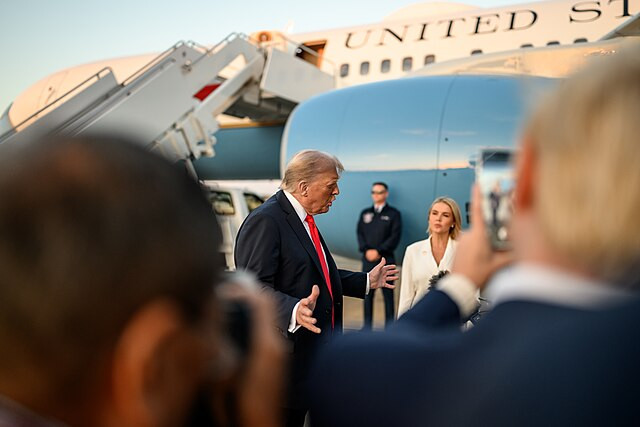
White House Press Secretary Karoline Leavitt will step down at the end of August, President Donald Trump announced Wednesday, forcing the administration to find a new public face ahead of the midterm elections after the youngest press secretary in U.S. history said she could no longer balance the demands of the job with raising two young children.
Leavitt, 28, returned to the West Wing last month after roughly seven weeks of maternity leave following the birth of her second child in May. She said becoming a mother again while serving in one of Washington's most relentless jobs had led her to reconsider whether she could continue giving both responsibilities the attention they required.
Trump announced the departure on Truth Social, praising Leavitt as a "real leader" and "one of the best White House Press Secretaries in the History of the Office." He said she wanted to spend more time with her children and family, a decision the president said he understood and respected.
In announcing her resignation, Leavitt described the period following the birth of her daughter as the most rewarding but challenging season of her life. Since returning from maternity leave, she said, she had concluded that she couldn't simultaneously be the mother she wanted to be and maintain the constant commitment demanded by the White House position.
Her departure ends a high-profile tenure that began when Leavitt was 27, making her the youngest person to serve as White House press secretary. She became one of the administration's most visible defenders, routinely fielding questions about policies that could shift rapidly as Trump made announcements through interviews, public appearances and social-media posts.
David E. Johnson, chief executive and founder of Strategic Vision PR Group, said the workload was particularly difficult because of Trump's management style. Johnson, who has worked on Republican political campaigns since 1986, told The Mirror US that "everybody knows Donald Trump is a very demanding boss."
Johnson said Trump maintained frequent contact with Leavitt even during her maternity leave and reportedly called her several times to ask when she planned to return. He argued that the demands became harder to reconcile with Leavitt's responsibilities at home after the birth of her second child.
The PR executive also said Trump appeared to have been surprised by Leavitt's decision. Based on the president's announcement, Johnson said, Trump appeared reluctant to lose an aide who had developed an unusual ability to understand and communicate his frequently changing political messages.
That skill could make replacing her more difficult than simply finding an experienced television communicator. Johnson described Leavitt as unusually adept at translating Trump's thinking into a coherent administration position even when the president changed direction quickly.
Trump could, for example, announce one position in a morning social-media post before shifting policy later in the day. Leavitt's value, Johnson argued, came from remaining composed while explaining those developments to reporters and defending them from the White House podium.
Her resignation also arrives at a politically sensitive point for the administration. With the midterm elections approaching, Johnson expects Democrats and the press to become increasingly aggressive in challenging the White House, placing additional importance on the administration's choice of a successor.
Leavitt had demonstrated that she could handle confrontational exchanges with reporters, Johnson said, but whoever follows her will need similar resilience. He predicted the administration would seek a forceful communicator capable of managing increasingly contentious briefings rather than substantially changing its media strategy.
Johnson also expects Trump to favor someone already familiar with his administration rather than recruiting a conventional outside communications professional. The president, he said, is likely to prioritize a candidate who understands his working style, performs well under pressure and can react quickly to shifting policy announcements.
Loyalty is also expected to weigh heavily in the selection. Leavitt's tenure was defined not only by her command of the briefing room but by her close alignment with Trump, making the search for her replacement as much about presidential trust as communications experience.