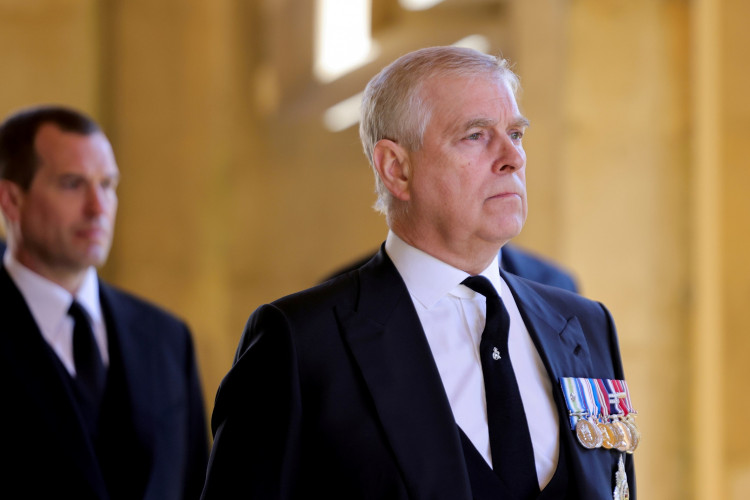
Andrew Mountbatten-Windsor could still receive a royal funeral involving a multimillion-dollar security and ceremonial operation despite losing his titles and public role amid years of scrutiny over his relationship with Jeffrey Epstein, according to reports that are prompting calls for the British government to abandon any such plans.
The former Duke of York reportedly remains covered by the Cabinet Office's advance funeral-planning process for senior members of the Royal Family. Such arrangements, sometimes referred to as "bridge plans," are prepared years in advance and can involve coordination among the palace, government agencies, police and the military.
One expert estimated that a substantial funeral for Andrew could carry an overall price tag of around $11 million, although that wouldn't mean taxpayers would necessarily cover the entire amount. Security and policing would be among the components most likely to generate significant public costs.
"If Andrew ultimately receives a large-scale royal funeral, the overall operation could probably cost around $11 million once substantial security, policing, crowd management, and ceremonial requirements are considered. That does not mean taxpayers would fund every element, but a major public security operation could leave them with a considerable bill," the expert told Stylecaster.
The prospect has attracted criticism because Andrew no longer performs official royal duties and has been stripped of military affiliations, titles and other privileges following the controversy surrounding his relationship with Epstein. U.S. attorney Spencer Kuvin, who represented Epstein victims, has argued that public funds shouldn't be used for Andrew's funeral.
Andrew has denied wrongdoing related to Epstein and allegations made against him. In 2022, he settled a civil sexual-assault lawsuit brought by Virginia Giuffre without admitting liability.
The controversy has intensified following Andrew's arrest in February on suspicion of misconduct in public office in connection with allegations involving his former position as a U.K. trade envoy and his dealings with Epstein. He was released after questioning, and the investigation remains ongoing.
Any funeral for Andrew wouldn't necessarily approach the scale of Queen Elizabeth II's state funeral. The Queen's funeral and associated period of national mourning cost the British government about $218 million, while Princess Diana's 1997 funeral has been estimated by RadarOnline at roughly $10.8 million in today's dollars.
Reports instead suggest Andrew could receive a more limited royal ceremony, potentially involving St George's Chapel and burial at the Royal Burial Ground at Frogmore. Even a smaller event, however, could require significant policing, security and crowd-control measures depending on its public profile.
Gloria Allred, another attorney who represented Epstein victims, has questioned whether Andrew should receive such ceremonial recognition at all.
"Andrew has brought disgrace upon the Royal Family and the UK as a result of his involvement with Jeffrey Epstein. Under these circumstances, the question arises as to why this man should be afforded the honour of a royal funeral. What kind of message would such a ceremony send to Epstein's victims?" Allred stated.
Political opposition has emerged as well. Conservative shadow Home Office minister Alicia Kearns has called for any plans granting Andrew a royal funeral to be revoked, arguing that his withdrawal from public life should extend to the arrangements surrounding his eventual burial.
"There are no circumstances under which Andrew should be afforded a royal funeral. He should live out his days far from public life, and the police should ensure their investigations into him are robust and don't drag on. All such plans should be revoked immediately," Kearns said.
Former British government minister Norman Baker has taken a similar position, saying Andrew is a "commoner and should in no way be getting any sort of royal funeral."
Andrew's supporters can point to a separate part of his public record: his military service. He served as a Royal Navy helicopter co-pilot during the Falklands War, an episode that has remained part of discussions over what military recognition, if any, would be appropriate at his funeral.
Retired Rear Adm. Chris Parry has said volunteers could potentially carry Andrew's coffin and noted that the former prince holds a Falklands medal. "You can't take that away from him," Parry said.