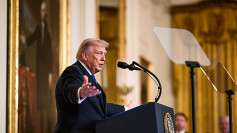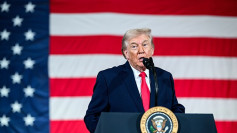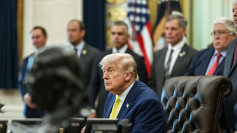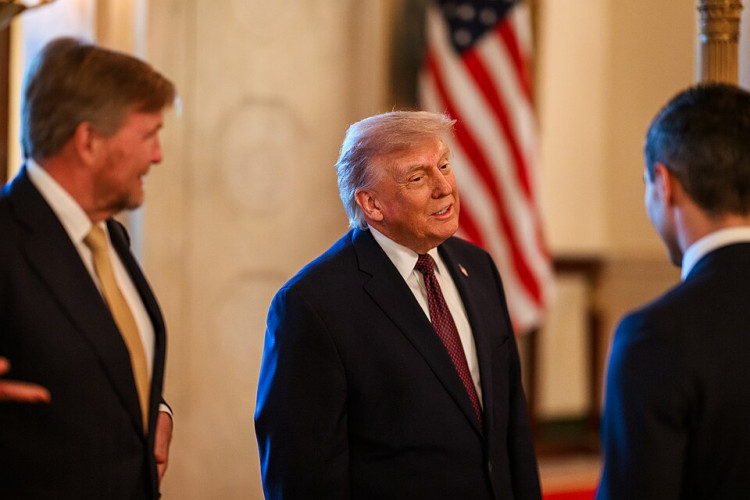
President Donald Trump's order to substantially reduce U.S.-South Korea military exercises has triggered criticism from former American diplomats and at least one Republican senator, intensifying questions about Washington's commitment to a seven-decade security alliance as North Korea expands its military cooperation with Russia.
The annual Ulchi Freedom Shield exercises began Monday and are scheduled to continue through Aug. 27, with roughly 18,000 South Korean military personnel expected to participate. South Korea's Joint Chiefs of Staff said the drills started as planned while officials from both countries worked through how Trump's directive would alter their scale.
Trump announced the decision Sunday, saying the exercises were expensive and sent an "inappropriate and hostile" message to North Korea. He cited his "very good relationship" with North Korean leader Kim Jong Un as part of his reasoning.
The president also raised South Korea's refusal to participate in U.S. efforts against Iran, while acknowledging that the matter was "somewhat unrelated." Reuters reported that Trump's objections encompassed both the cost of the exercises and Seoul's position on Iran.
South Korea responded cautiously. The Blue House said it was reviewing Trump's remarks and expressed hope that his relationship with Kim could help create an opening for dialogue and greater stability on the Korean Peninsula, while pledging continued coordination with Washington on their combined defense posture.
The move nevertheless drew unusually sharp criticism from former U.S. officials. Andrew Weinstein, a former U.S. representative to the United Nations, portrayed Trump's approach as a fundamental danger to American alliances and went further by questioning the president's mental condition.
"We are past the point of political disagreement," Weinstein wrote on X. "We are witnessing a catastrophic collision between unchecked narcissism and obvious neurological decay. It is the most dangerous intersection in American history: a man with the absolute power of the Presidency and the absolute cognitive failure of a person no longer tethered to reality."
Weinstein's statements about neurological and cognitive decline are his opinion, not a medical finding. The provided reporting offers no evidence that Weinstein has examined Trump or is qualified to diagnose him, and his remarks shouldn't be treated as an established assessment of the president's health.
Weinstein also argued that Washington was placing accommodation of Pyongyang ahead of military readiness. "Turns out U.S. military readiness becomes strangely flexible when the priority is not upsetting a dictator who runs forced labor camps, starves his own people as punishment, and executes citizens for watching foreign media," he wrote.
Luis Moreno, a former Foreign Service officer and ambassador, separately described Trump's position as an "unprecedented betrayal," arguing that it favored North Korea over South Korea. Former U.S. Ambassador to Russia Michael McFaul said Trump was handing Kim "a new gift" without receiving a corresponding concession.
Criticism also came from within Trump's party. Republican Sen. Thom Tillis of North Carolina emphasized that South Korea has been a "solid military ally for over 70 years" and warned that reducing exercises could indirectly benefit North Korea's military support for Russian President Vladimir Putin.
"Reducing joint exercises with South Korea does nothing more than free up thousands of North Korea's troops to support Putin's systematic kidnapping, torture, rape, and murder of innocent Ukrainian citizens," Tillis wrote on X.
The controversy comes at a sensitive moment for the peninsula. North Korea recently resumed missile testing with the launch of a short-range ballistic missile, while U.S. and South Korean military officials have warned that Pyongyang is gaining battlefield experience through its support for Russia's war in Ukraine.
Ulchi Freedom Shield combines live, virtual, constructive and field-based training intended to prepare the two militaries for a range of threats. North Korea has long denounced such exercises as preparations for invasion, while Washington and Seoul have characterized them as defensive.
Trump has previously sought to reduce military exercises as part of his diplomacy with Kim. During his first term, he criticized joint drills as costly and provocative and suspended some exercises following his 2018 summit with the North Korean leader, though those talks didn't produce an agreement ending Pyongyang's nuclear-weapons program.
Reuters cited analysts who said the latest move could represent another attempt to reopen diplomacy with Kim. That effort now comes as North Korea maintains its nuclear and ballistic-missile capabilities while strengthening its relationship with Moscow.