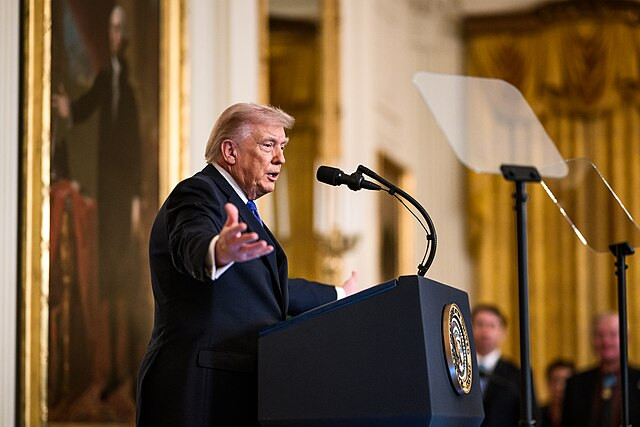
President Donald Trump repeatedly referred to women as "young, beautiful girls" during a Friday appearance in Garden City, N.Y., drawing criticism online as he used an anecdote about White House employees to argue that his administration has made Washington, D.C., safer.
Speaking to police officers at the Nassau County Police Academy Center for Training and Intelligence, Trump was touting falling crime and describing what he said were encounters with women who work at the White House. He said they had personally thanked him because they now felt comfortable walking through Washington.
"You know these young, beautiful girls. These young, beautiful girls. These young, beautiful girls in the White House," Trump said.
Trump then appeared to anticipate criticism of his wording. "Now I'm not supposed to say beautiful, but what the hell?" he said, before referring to the women as "these gorgeous, beautiful girls."
The remarks quickly circulated online, where critics focused on the president's repeated use of "girls" rather than women. One commentator wrote, "This makes me physically sick," while arguing that Trump could simply have referred to them as "young women" or "women."
Trump's broader point was that people who previously feared walking through Washington now felt safer because of his administration's crime policies. He acted out what he described as one of his conversations with a woman who approached him at the White House.
"Mr. President, may I speak to you? Thank you, sir. Thank you," Trump said, recounting the supposed exchange.
Trump said he then asked why she was thanking him. According to the president's retelling, the woman responded: "Because a year and a half ago, I was afraid to leave. I was afraid to open the door of my apartment, and now I walk to the White House every morning, and I have absolutely no fear."
The anecdote was part of Trump's effort to portray Washington as dramatically safer under his leadership. During his remarks in New York, he described the capital as "one of the safest cities in the country" and pointed to his administration's use of the National Guard as an important part of the turnaround.
The political dispute over who deserves credit is more complicated. Violent crime had already been falling before Trump returned to the White House, while researchers have documented substantial declines across cities governed by both Democrats and Republicans.
The Council on Criminal Justice, for example, reported that homicides declined 18% from the previous year across the cities included in its analysis. That represented 254 fewer killings, indicating that the reduction extended well beyond Washington and any single federal initiative.
Trump has nevertheless repeatedly tied improvements in public safety to his administration while contrasting his approach with that of the Biden administration. Crime has remained a central part of his political message, particularly his argument that a more aggressive federal role in law enforcement can restore order in major American cities.