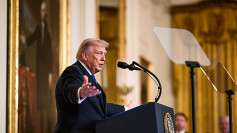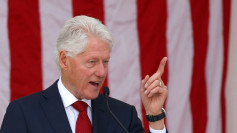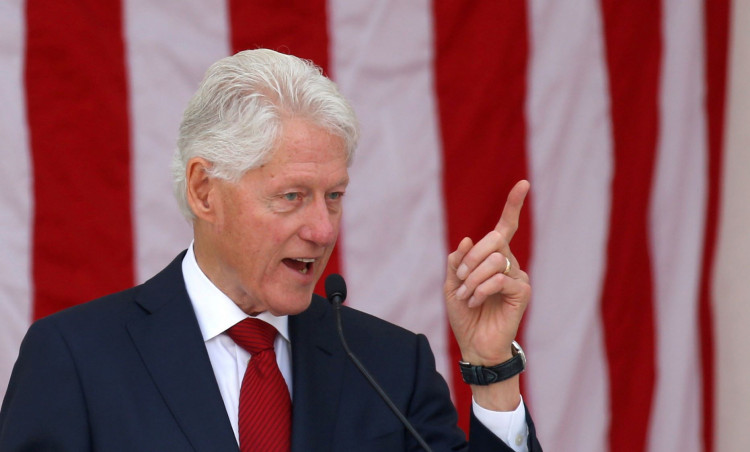
Former President Bill Clinton mocked President Donald Trump's proposal to turn a planned 250-foot triumphal arch in Washington into a military facility for drones and snipers, using his opening address at the Clinton Global Initiative in New York on Tuesday to criticize the administration's priorities and warn against the concentration of political power.
Clinton did not mention Trump by name during his September 22 remarks, but repeatedly referenced initiatives associated with the president, including the proposed arch near Arlington National Cemetery and the dispute over renaming the John F. Kennedy Center for the Performing Arts. His comments drew laughter from the audience before he turned to broader concerns about political division and government accountability.
"I suppose I could take my entire allotted time to discuss the self-evident wisdom of building an Arc de Triomphe in Washington to hold all our drones," Clinton said.
"Some of this stuff, it's hard to make up," he added, drawing laughter from the audience.
Trump has proposed building the monument near Arlington Memorial Bridge as part of his plans to reshape prominent Washington landmarks. He subsequently announced that the structure would also serve military purposes, including housing drones, sniper positions and ammunition, citing national security requirements.
The proposal has attracted scrutiny because of its location near Reagan Washington National Airport. The Federal Aviation Administration previously assessed the planned structure and cleared it subject to conditions, but its review did not cover the potential operation of military drones from the site.
The arch would stand approximately 3,000 feet from the airport, near major approach and departure corridors. Aviation experts and lawmakers have questioned whether the addition of drone operations would require a separate safety assessment, raising issues beyond those considered during the initial review.
Clinton also addressed the dispute surrounding Trump's effort to attach his name to the Kennedy Center, another Washington landmark that has become the subject of litigation. U.S. District Judge Christopher Cooper recently blocked the institution's board from proceeding with the proposed name change, citing legal restrictions governing the memorial.
Rather than focusing exclusively on the naming dispute, Clinton questioned whether the political attention devoted to it was justified.
"I personally think that the way we've argued about what's going on at the Kennedy Center and all that kind of stuff, I think we've been majoring in the minors," he said.
"You really think 100 years from now anybody's going to care very much about whose name's on what building?" Clinton asked.
"Isn't it more important what happens in the building? And what happens outside the building?"
The former president used the controversy to introduce a broader argument about cooperation and political priorities. Speaking as the United States marks its 250th anniversary, he criticized an approach to politics that treats every dispute as a contest in which one side must lose for the other to succeed.
"I believe that on the 250th anniversary of this country, we can't have a politics driven by zero-sum thinking: In order for me to win, you have to lose," Clinton said.
He also raised concerns about the use of federal authority, alleging that government power was being employed to pursue political opponents and reward allies. Clinton described what he viewed as threats to free expression and accused those currently holding power of applying different standards to themselves and others.
"Some days I can hardly believe what is happening in this country that I love so much," Clinton said.
He alleged that the federal government had been "weaponised" to settle personal scores, prosecute enemies and suppress free speech. He also accused those in power of turning government into "a new profit centre for themselves and their allies," arguing that such conduct conflicted with the Constitution's Emoluments Clause.
Those allegations formed part of Clinton's criticism of the administration rather than findings established during his speech. Trump has defended his Washington construction projects on national security and commemorative grounds, while critics have challenged their necessity, legality and potential effects on historic landmarks.