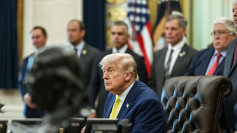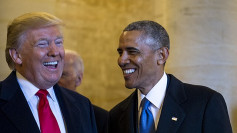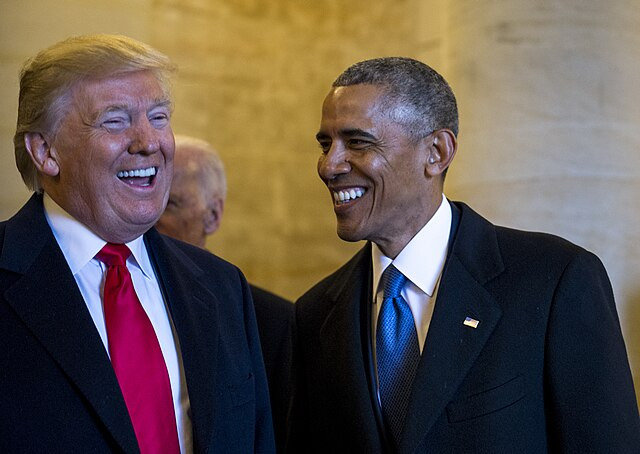
President Donald Trump dismissed former President Barack Obama's assertion that governments would perform better if women were put in charge for two years, calling the idea "ridiculous" during an exchange with reporters outside the White House on Saturday. The response drew criticism online, including from one user who labeled Trump a "nasty old misogynist."
Trump, 80, was preparing to leave Washington for Tennessee on Sept. 26 when a reporter asked him about remarks Obama made earlier in the week at Salem State University in Massachusetts. Obama, 65, had presented the idea as a hypothetical rather than a policy proposal, arguing that female leadership would likely improve government performance.
"Barack Obama just said if you put women in charge of every government for two years, things would be better. Do you buy that?" the reporter asked Trump.
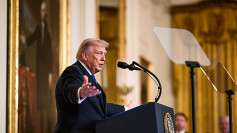
"It's ridiculous. I love women. I think they're great. But what a ridiculous statement that is," Trump responded. He then turned the question back toward the reporter, adding, "Even you would say that."
Obama made the comments Monday during a conversation with presidential historian Doris Kearns Goodwin at Salem State. The university hosted the former president as part of its Salem State Series, a program that has brought political leaders and other prominent public figures to the Massachusetts campus since 1982.
"I have a strong belief that things would... they wouldn't be perfect, but they'd be better. I'm confident about that," Obama said of the hypothetical prospect of women temporarily running governments around the world.
The idea wasn't new. During a leadership event in Singapore in December 2019, Obama made a similar argument, telling women in the audience that while they weren't perfect, they were "pretty indisputably" better than men. He said then that putting women in charge of every nation for two years would produce significant improvements in living standards and other outcomes.
Trump's response circulated widely after video clips from the White House press exchange were posted online and broadcast by news organizations. Some social-media users interpreted his rejection of Obama's hypothetical as another example of his contentious rhetoric involving women, while others treated his answer as a rejection of Obama's broad generalization about leadership based on gender.
"Pffff. He 'loves' women alright. Nasty old misogynist," one X user wrote in response to coverage of Trump's remarks. Another user described the president as an "emotional, idiot man-baby." Those comments represent individual reactions rather than broader measures of public opinion.
The exchange also revived memories of Trump's "nasty woman" remark about Hillary Clinton during their final presidential debate in October 2016. Trump made the comment while Clinton was discussing Social Security and taxes, and the phrase was subsequently embraced by some of her supporters.
During that 2016 debate, Trump had also said that "nobody has more respect for women than I do," after Clinton raised allegations concerning his treatment of women. His rhetoric toward female political opponents and journalists has remained a recurring subject of political debate since his first presidential campaign.
Trump and Obama have maintained a combative public relationship since Obama left the White House and Trump succeeded him in January 2017. Their latest disagreement centered less on a specific government program than on contrasting views about gender and political leadership.
Trump's comments came during a broader question-and-answer session in which he addressed several foreign-policy issues before departing for Tennessee. He also said he had rejected a proposal from Iran that had emerged from indirect negotiations in New York earlier in the week.
"They have made a proposal and I rejected it," Trump said.
Obama, meanwhile, had framed his women-in-government remarks within a wider discussion of leadership and generational change. His formulation included an explicit qualification that female-led governments wouldn't be "perfect," while asserting that he remained confident the overall results would improve.