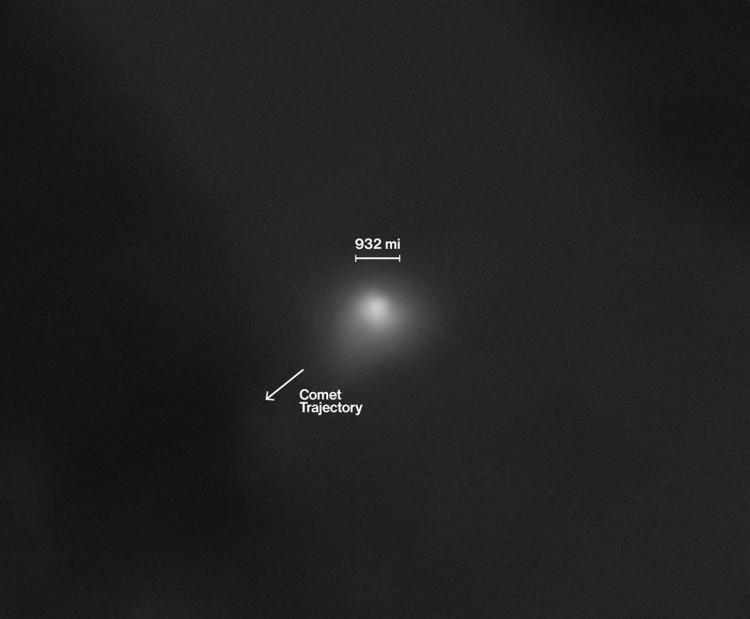
(Photo: NASA/JPL-Caltech/University of Arizona)
Astronomers are racing to analyse new Hubble Space Telescope images of interstellar comet 3I/ATLAS, an object with a highly unusual dual-tail structure and exotic chemical signatures that set it apart from comets born in the solar system. The European Space Agency and NASA confirmed that Hubble's Wide Field Camera 3 captured the latest images on Nov. 30, 2025, as the comet moved 286 million kilometres from Earth ahead of its closest approach on Dec. 19.
The object-only the third confirmed interstellar comet after 'Oumuamua and Borisov-was first detected on July 1 by the ATLAS telescope in Chile. Its hyperbolic trajectory immediately classified it as an interstellar visitor, arriving at high velocity before reaching perihelion on Oct. 29 inside Mars' orbital path. Early ground-based observations suggested modest activity, but the new Hubble imagery reveals a far more complex and active body than initially expected.
Hubble's tracking method, which locks onto the fast-moving comet, rendered background stars as elongated streaks. ESA's Hubble account highlighted the effect, noting: "Hubble tracked the comet as it moved across the sky. As a result, background stars appear as streaks of light." Scientists say the technique underscores the comet's rapid motion but also provides clarity on its dynamic tail structures.
The spacecraft detected a teardrop-shaped coma with an unusual anti-tail pointing toward the Sun, indicative of heavy dust grains that solar radiation cannot easily sweep away. Two distinct tails emerge in the Hubble data: a slender, upward-pointing gas tail of ionised particles, and a broader dust tail extending to the left. Spectroscopy revealed an atypical chemical mix, including a high carbon-dioxide-to-water ratio, cyanide gas, and atomic nickel vapour-conditions more similar to exoplanetary debris fields than local comets.
Amateur astronomers on X have speculated about cryovolcanism, citing images that appear to show jets or eruptions after perihelion. Some noted early outgassing at 3.8 AU and a colour shift from red to blue-green as heating intensified. Although unverified, these observations underscore the comet's unusually active profile. Size estimates for the nucleus range from 427 to 440 metres, though Hubble has yet to resolve it directly, leaving significant uncertainty about its structure.
Multiple missions across NASA and ESA have independently targeted the comet. The James Webb Space Telescope examined its chemical makeup in August 2025. ESA's Jupiter-bound Juice spacecraft passed near the object around perihelion, imaging both tails. Mars-based assets also contributed: the Perseverance rover captured ground-level views on Oct. 4, and MAVEN detected ultraviolet emissions from the comet's hydrogen halo. Additional observations from Psyche, Lucy, and SOHO tracked evolving gas plumes and dust behaviour.
Public fascination has intensified as images circulated online. WION published a video report praising the new visuals, stating: "NASA's Hubble and ESA's Juice spacecraft have captured stunning new images of comet 3I/ATLAS as it nears its closest approach on December 19." While social-media speculation has ranged from natural anomalies to imaginative theories of artificial origin, researchers emphasize that the evidence supports complex but natural cometary processes.