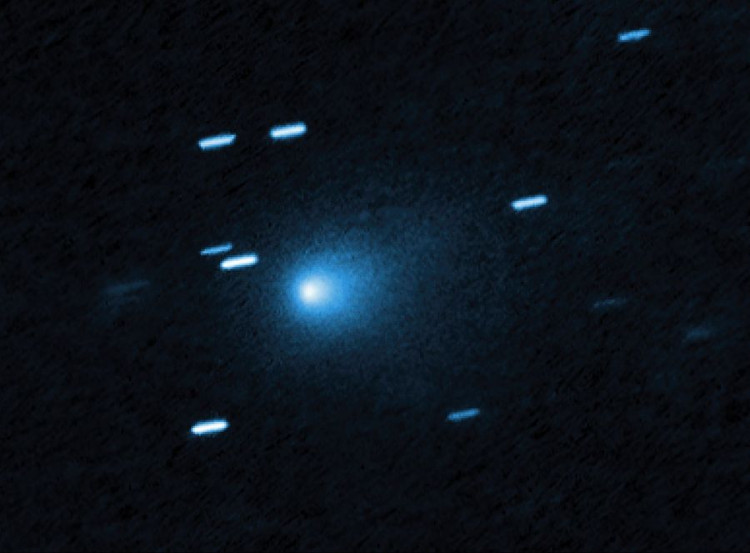
(Photo: NASA, ESA, David Jewitt (UCLA); Image Processing: Joseph DePasquale (STScI))
Astronomers around the world are accelerating their study of Comet 3I/ATLAS, the third confirmed interstellar object to enter the solar system, as it prepares for its closest approach to Earth on December 19 at a distance of about 167 million miles. The object, discovered on July 1, 2025, by the NASA-funded ATLAS telescope in Chile, has drawn intense scientific attention as a pristine sample of material from another star system.
The comet follows only two previous confirmed interstellar visitors: the elongated, tail-less 'Oumuamua detected in 2017 and the more conventional comet 2I/Borisov in 2019. Unlike both predecessors, 3I/ATLAS is arriving with extensive telescope coverage, including coordinated observations from NASA's Hubble Space Telescope, the James Webb Space Telescope and the European Space Agency's Juice spacecraft.
Hubble captured some of the earliest detailed views of the comet shortly after its discovery, recording its teardrop-shaped coma and refining models of its trajectory. A second observation on November 30 produced a clearer image as the comet traveled 178 million miles (286 million kilometers) from Earth, using the Wide Field Camera 3 to resolve its complex structure and estimate the nucleus at between 440 meters and 5.6 kilometers across.
JWST data has added a striking chemical clue to the comet's origins. According to NASA, the telescope detected an unusually high ratio of carbon dioxide to water ice - a combination rarely seen in solar-born comets. Scientists say this suggests 3I/ATLAS formed in a markedly different environment around its parent star, likely older than the sun. This material was released as the comet's ices sublimated during its close solar pass in October.
The ESA's Juice spacecraft - launched in 2023 for a long-term mission to Jupiter's moons - found itself in a favorable position to observe the comet during its early November flyby at a distance of 41 million miles (66 million kilometers). Despite limited bandwidth caused by the spacecraft using a smaller antenna, mission teams downloaded a partial NavCam image revealing a glowing coma and two tails: a plasma tail of electrically charged gas and a faint dust tail trailing behind.
The detour underscores the unusual timing. Juice, not expected to reach Jupiter until 2031, was able to dedicate five instruments and its navigation camera to study a comet unlikely to be seen again by humanity. The small slice of transmitted data has already shaped scientists' understanding of the comet's heat-driven activity as it left its perihelion.
NASA notes that the comet poses no threat as it passes on the far side of the sun, well beyond Earth's orbit. But its fleeting presence offers a rare chance to study unprocessed material from a foreign stellar system. Astronomers expect 3I/ATLAS to remain visible to major observatories for several more months before exiting the solar system permanently.