(Photo: NASA/JPL-Caltech/University of Arizona)
An interstellar comet making a brief passage through the solar system has triggered one of the largest coordinated astronomical observation efforts in recent memory. Comet 3I/ATLAS, only the third confirmed object to visit from another star system, has been photographed by missions across the United States, Europe and Mars as it continues its trajectory toward the outer solar system. NASA's Hubble Space Telescope and the European Space Agency's Juice spacecraft released new images last week showing the comet's glowing coma and what may be two distinct tails.
The comet was first detected in July by the NASA-funded Asteroid Terrestrial-Impact Last Alert System in Rio Hurtado, Chile. At discovery, it was more than 420 million miles from Earth, but its unusual hyperbolic path immediately signaled that it originated beyond the solar system. Only two previous interstellar objects have been documented: the elongated 'Oumuamua in 2017 and Comet 2I/Borisov in 2019.
The new images underscore why the scientific community has mobilized so aggressively. Juice, currently en route to Jupiter, captured photographs shortly before its Nov. 4 flyby at roughly 41 million miles. The spacecraft recorded a bright coma and differentiated a "plasma tail," made of electrically charged gas, from a broader "dust tail" of solid particles. Hubble's observations, taken late last month from a distance of approximately 178 million miles, showed the fast-moving comet as a sharp point of light against star trails.
Efforts to identify the object's chemistry accelerated in August when NASA's SPHEREx mission spent eight days analyzing the comet's atmosphere from about 290 million miles away. SPHEREx detected water ice and carbon dioxide in the coma, a chemical mix that mirrors that of comets formed in the solar system. The findings challenge assumptions that interstellar objects should display significantly different compositions.
As the comet approached the sun in late summer, ground-based observatories documented rising activity. The Gemini South telescope in Chile released September images showing an elongated tail and increasingly energized coma. NASA and ESA missions-including SOHO, PUNCH, Lucy, MAVEN and the Perseverance rover-added additional tracking data as the comet brightened during its late-October perihelion.
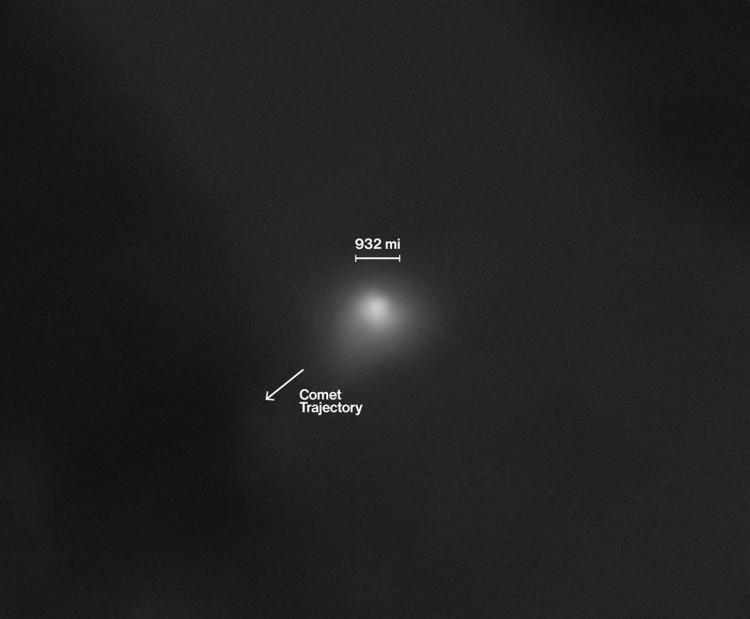
ESA's ExoMars Trace Gas Orbiter also contributed to the international campaign, spending a full week observing the comet beginning Oct. 1 from a distance of about 18.6 million miles. The orbiter recorded the comet's motion as a faint white blur crossing deep space, data that helped refine models of its trajectory.
3I/ATLAS will reach its closest point to Earth on Dec. 19, though at a safe distance of about 170 million miles. The interstellar object is expected to fade from view in the coming months as it sweeps back toward interstellar space. ESA said additional Juice data will be downlinked in February, providing higher-resolution imaging and compositional measurements from the spacecraft's scientific instruments.