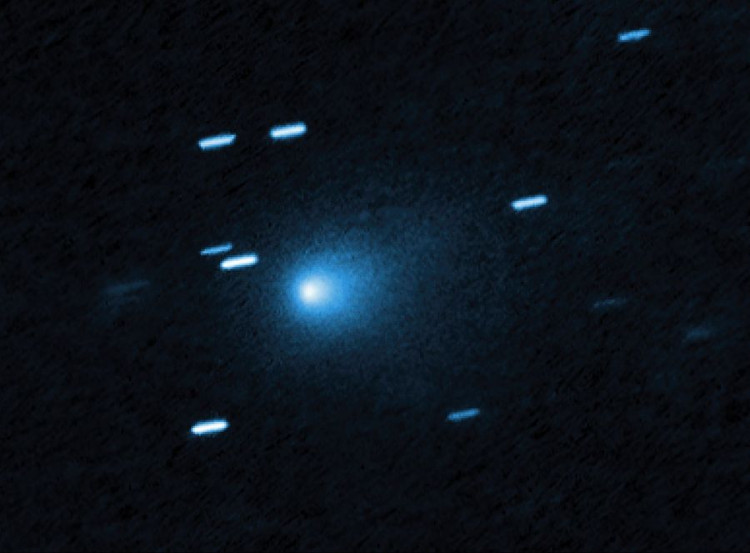
(Photo: NASA, ESA, David Jewitt (UCLA); Image Processing: Joseph DePasquale (STScI))
The debate over the interstellar object 3I/ATLAS escalated sharply this week as a scientist publicly accused amateur astronomers of manipulating images to make the visitor appear "alien," challenging claims that the object's unusual features point toward artificial origins. The dispute comes as NASA, the European Space Agency and several observatories continue monitoring the comet-like body ahead of its closest approach to Earth on December 19, 2025.
3I/ATLAS, detected in July by the ATLAS survey in Chile, is only the third confirmed interstellar object to enter the solar system. Travelling at roughly 153,000 miles per hour at perihelion, it displayed several atypical characteristics, including a pronounced anti-tail pointing toward the Sun and narrow jets of material, features that deviated from standard cometary behaviour and fueled a wave of speculation across social platforms.
Some of that speculation originated from Harvard astrophysicist Avi Loeb, who has argued that the anomalies justify considering non-natural explanations. "It might be an alien spacecraft," Loeb suggested, while criticizing NASA for asserting that the object's behaviour remains consistent with natural dynamics. NASA's own imagery, released on November 19 and described on X with the note, "We've just released our newest images of the interstellar comet 3I/ATLAS," drew attention for its lack of detail, prompting armchair analysts to circulate enhanced images showing dramatic plumes and surface textures.
The emergence of those images prompted a forceful rebuttal from an anonymous scientist who posted a lengthy critique on Reddit. "Amateur astronomers can physically not make any detailed observations of the comet," the astronomer wrote, arguing that atmospheric distortion and distance make anything beyond coarse features impossible to detect. The post further alleges that supposed surface structures or textures are "artifacts," not real morphology.
The critic directly challenged Loeb's claims, asserting that "Loeb does not want to convince experts, he wants to convince people who know less than he does." According to the astronomer, the use of aggressive digital enhancement tools transforms noise into patterns that can be misinterpreted as evidence of alien design. Professionals, the post argues, routinely disregard such patterns as optical artifacts produced by stacking software or atmospheric interference.
Supporters of the Reddit critique noted that amateur images frequently show artificial streaks, diffraction spikes and sharpening distortions similar to those occasionally seen in high-power observations, such as the star-ray artifacts from the James Webb Space Telescope. According to the post, these are often misinterpreted by enthusiasts as signs of solid structures or engineered surfaces, despite being well-known quirks of the imaging process.
NASA's own observations, which show the comet surviving its passage around the Sun despite losing mass, have done little to quiet speculation. Organic molecules have been detected in its coma, a finding consistent with both solar-system comets and interstellar visitors, leaving open multiple interpretations about its composition and origin.