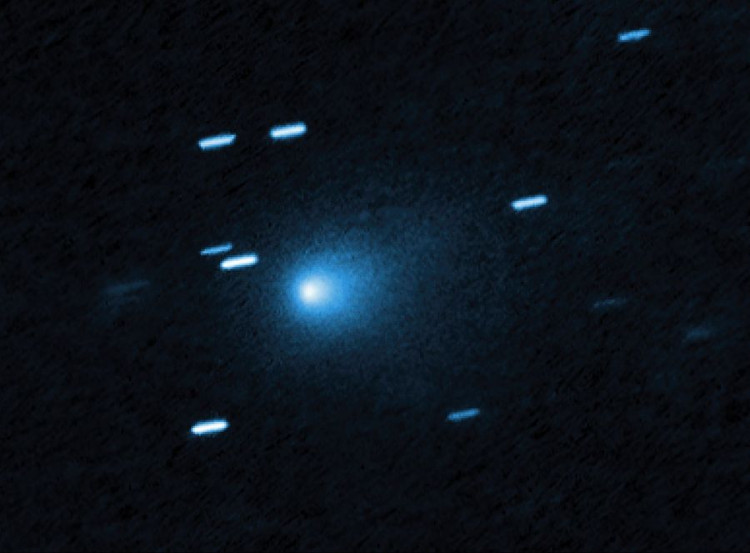
(Photo: NASA, ESA, David Jewitt (UCLA); Image Processing: Joseph DePasquale (STScI))
Interstellar comet 3I/ATLAS is reshaping scientists' understanding of how life-forming chemistry may arise beyond the Solar System, as new observations from U.S., European and Japanese missions reveal unusually enriched organic molecules and X-ray emissions never before detected from an alien object. The comet, discovered in July 2025 by NASA's ATLAS survey in Chile, is only the third confirmed visitor from another star system and is passing through the inner Solar System on a one-time trajectory before it disappears back into interstellar space.
Its hyperbolic orbit and high velocity confirm it is not gravitationally bound to the Sun, giving researchers a narrow window to study material formed around another star billions of years ago. Scientists say the object's chemistry is unlike anything observed in native comets, fueling speculation that life's precursors may be common across planetary systems. A NASA astrochemist described the molecular abundances detected on 3I/ATLAS as "among the most enriched values measured in any comet," placing the object at the center of one of the most ambitious multi-mission observation campaigns ever coordinated.
Data from the Atacama Large Millimeter/submillimeter Array in Chile provided the first major surprise: extraordinarily high concentrations of methanol and hydrogen cyanide boiling off its surface. Roughly 8% of all vapor escaping from the nucleus consists of methanol-about four times the typical levels found in Solar System comets-while hydrogen cyanide also appears significantly elevated. The enriched mixture forms a classic chemical foundation for sugars, amino acids and other organic compounds central to theories of life's emergence.
Additional evidence came from Japan's X-Ray Imaging and Spectroscopy Mission, which detected a diffuse X-ray halo extending roughly 250,000 miles around the comet. The emissions were generated by charge-exchange reactions between solar wind ions and the comet's expanding cloud of neutral gas. Analysis showed excess X-ray activity at energies associated with carbon, nitrogen and oxygen ions, revealing how an interstellar object interacts with the solar wind in real time.
As researchers rushed to collect data before the comet fades, NASA mobilized a suite of spacecraft across the Solar System. The Hubble Space Telescope captured a blue-green glow on November 30, likely from cyanogen, ammonia and sunlight-reflecting dust. The European Space Agency's JUICE mission identified two distinct tails-a plasma tail and a fainter dust tail-while the Mars Reconnaissance Orbiter and MAVEN collected ultraviolet and high-resolution imagery as 3I/ATLAS passed within 19 million miles of Mars.
Even surface assets joined the campaign. NASA's Perseverance rover photographed a faint smear of the distant comet as it moved across the Martian sky. Deep-space probes including Lucy, Psyche, Europa Clipper and the Parker Solar Probe have also taken measurements or stand ready to observe the object as geometry permits, marking the first time multiple heliophysics missions have tracked an interstellar comet.
3I/ATLAS is expected to make its closest pass to Earth on December 19 at approximately 1.8 astronomical units, or about 170 million miles-well beyond any hazardous range. At magnitude 9 to 11, it remains invisible to the unaided eye and accessible only to advanced telescopes. After March 2026, it will swing past Jupiter at roughly 0.36 astronomical units before being ejected into interstellar space forever.