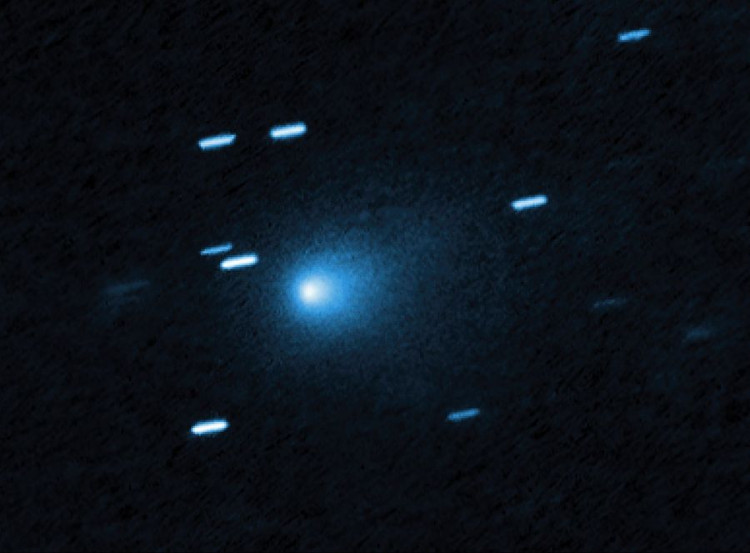
(Photo: NASA, ESA, David Jewitt (UCLA); Image Processing: Joseph DePasquale (STScI))
The arrival of interstellar comet 3I/ATLAS in the inner Solar System in late 2025 sparked a burst of scientific observation-and a parallel surge of online claims that U.S. authorities had quietly tracked the object for decades through a classified planetary defense program known as CASSANDRA. No U.S. agency has confirmed the existence of such a program or any prior monitoring of the comet, and scientists say the evidence cited online does not withstand scrutiny.
The claims gained traction as astronomers worldwide released imagery and data following the comet's detection, while NASA offered comparatively limited public comment during the early verification phase. That gap, experts say, is common during fast-moving observations, but it became a focal point for speculation on forums and social platforms asserting foreknowledge.
At the center of the allegations are unverified images and labels circulating online that purport to show structured plasma emissions associated with 3I/ATLAS. Posts referenced filenames such as "CASSANDRA / ORACLE VI ARGUS-VIS" and "C/2025 N1 UMBRA-3/C," though the provenance of the images has not been established and no recognized observatory has authenticated them.
The speculation intensified after users pointed to a 2005 academic paper presented at the International Astronautical Congress in Valencia titled "Cassandra: A Strategy to Protect Our Planet from Near-Earth Objects." Researchers familiar with the work say the paper outlined a conceptual framework for early detection of hazardous objects, not an operational system, and there is no public evidence it was funded or deployed.
Scientists contacted by mainstream outlets caution that the physical behaviors cited online-such as apparent non-gravitational trajectory changes-are consistent with known cometary physics. Outgassing jets, radiation pressure, and uneven sublimation can produce angular offsets without invoking artificial control or surveillance.
What is confirmed about 3I/ATLAS is narrower and less sensational. Observations show it is only the third known interstellar object detected passing through the Solar System, following 1I/ʻOumuamua and 2I/Borisov. Its hyperbolic trajectory, speed and chemical signatures align with an extrasolar origin, according to data released by multiple international observatories.
Key verified points include:
- Detection in mid-2025 and rapid follow-up by ground- and space-based telescopes
- A trajectory unbound to the Sun, confirming an interstellar source
- Chemical signatures consistent with natural cometary composition
Astrophysicists say the name "Cassandra," drawn from Greek mythology, is frequently used in academic proposals and does not imply secrecy or prophecy. They note that mythological naming conventions are commonplace in space science and defense research.