(Photo: NASA/JPL-Caltech/University of Arizona)
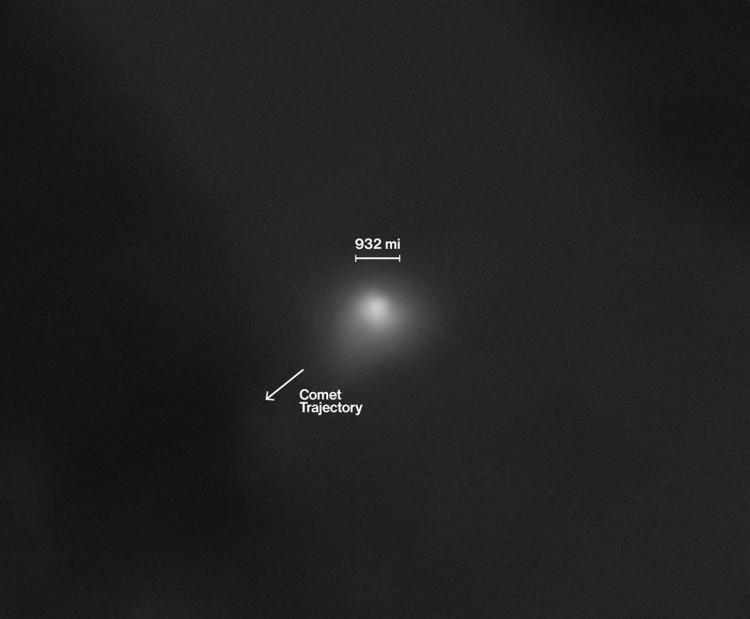
Astronomers are intensifying scrutiny of interstellar object 3I/ATLAS after images captured this week revealed a massive, sunward-facing anti-tail extending roughly half a million kilometers-longer than the average distance between Earth and the Moon-an observation that challenges conventional comet physics as the object approaches its closest pass by Earth.
The feature was documented at 02:28:12 UTC on Dec. 15, 2025, in Calabria, Italy, by astrophotographer Toni Scarmato using a 0.25-meter telescope. Subsequent image processing with a Larson-Sekanina rotational gradient filter showed a coherent structure pointing toward the Sun rather than away from it, persisting across multiple exposures and spanning a mapped field of view of approximately 0.86 by 0.39 million kilometers.
Anti-tails are not unknown in cometary science, but they are typically optical effects-dust aligned along an orbital plane that appears sunward from specific viewing angles. Researchers reviewing the 3I/ATLAS data say the scale, persistence, and apparent growth rate of this structure argue against a projection illusion or background artifact.
As of Dec. 15, the object was about 270 million kilometers from Earth. It is expected to reach closest approach on Dec. 19 at roughly 268.9 million kilometers, a marginal change in distance but a critical window for observation. To reach half a million kilometers in the roughly 45 days since perihelion, material in the feature would need a minimum sunward velocity of about 130 meters per second, according to estimates based on observed geometry.
Such sustained motion is difficult to reconcile with standard explanations such as solar radiation pressure or isotropic sublimation from exposed ice. Researchers are testing alternative natural mechanisms, including extreme rotation, highly anisotropic outgassing, or unusual grain-size distributions, though each requires assumptions that stretch existing cometary models.
The anomaly is sharpening focus on the limited census of interstellar objects detected to date. Current survey systems, including Pan-STARRS and ATLAS, are most sensitive to objects larger than roughly 100 meters within distances comparable to the Earth-Sun separation, leaving scientists with a sparse and biased sample of a much larger population.
The unusual behavior has revived discussion around directed ejection models. Harvard astrophysicist Avi Loeb, who has argued for rigorous consideration of outliers, has said that when observations resist standard categories, "the possibility of technological origin should not be dismissed out of hand." Researchers emphasize that such remarks do not assert an artificial explanation, but underscore the need to account for thrust-like behavior as a physical process.
Beyond theory, the findings carry implications for planetary defense modeling. Agencies such as NASA's Planetary Defense Coordination Office typically assess trajectories assuming passive motion. An object capable of sustained, directional mass loss could, in principle, introduce non-gravitational effects that complicate long-term path predictions.