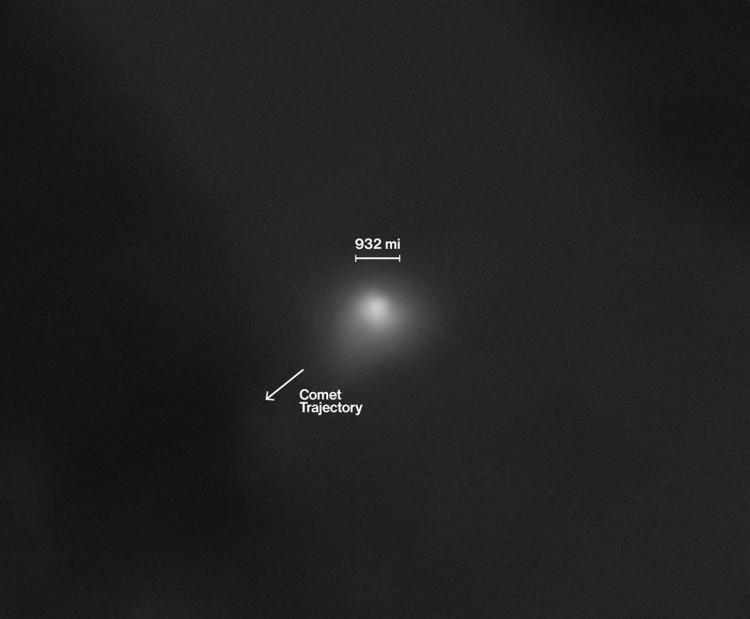
(Photo: NASA/JPL-Caltech/University of Arizona)
Astronomers studying the interstellar object known as 3I/ATLAS say new observations from the Gemini North Telescope in Hawaii have revealed a striking chemical transformation as the comet exits the inner solar system, underscoring how little is known about material formed around distant stars. The object, first detected by NASA's Asteroid Terrestrial-impact Last Alert System on July 1, 2025, is only the third confirmed visitor from outside the solar system, following 1I/'Oumuamua in 2017 and 2I/Borisov in 2019.
Data collected after the comet's close pass by the Sun show that 3I/ATLAS has shifted in appearance from a muted red to a faint green glow, a change scientists attribute to the release of diatomic carbon as solar heat penetrates its icy nucleus. The observations were captured by Gemini North on Maunakea as the object receded from the Sun, offering one of the clearest chemical signatures yet recorded from an interstellar comet.
The comet reached solar conjunction on Oct. 21 and made its closest approach to the Sun on Oct. 29, passing at a distance of roughly 12.9 million miles, or 0.139 astronomical units. During that encounter, rising temperatures triggered the sublimation of volatile compounds, producing emissions rarely observed in objects originating beyond the solar system.
Astronomers say the green hue is a classic marker of diatomic carbon, an extremely reactive molecule commonly seen in comets but seldom documented in interstellar objects with this level of clarity. The detection adds to a growing list of chemical anomalies that distinguish 3I/ATLAS from comets formed within the Sun's gravitational influence.
The object's velocity has further heightened scientific interest. Even after slowing slightly due to solar gravity, 3I/ATLAS is racing out of the solar system at roughly 150,000 miles per hour, or about 67 kilometers per second, making it the fastest and most energetic interstellar object observed to date. Its hyperbolic trajectory confirms that it is not bound to the Sun and will never return.
Researchers are also puzzled by what the comet does not show. While nickel has been detected in its coma, iron-typically present in similar amounts in solar system comets-has yet to appear. That imbalance suggests the object may have formed in a chemically distinct environment, potentially offering rare insight into planet-forming processes around other stars.
Public engagement has become a notable part of the campaign to study 3I/ATLAS. Through a program called Shadow the Scientists, students in Hawaii and Chile have been invited to observe data collection sessions remotely alongside professional astronomers. Bryce Bolin, a research scientist at Eureka Scientific involved in the initiative, said, "Sharing an observing experience in some of the best conditions available gives the public a truly front-row view of our interstellar visitor."
Bolin added that exposing the public to live observing sessions helps demystify astronomy and underscores the collaborative nature of modern space science. The program has allowed participants to watch telescopes reposition in real time as data from Gemini and other facilities are gathered.