(Photo: NASA/Goddard/SwRI/JHU-APL)
Scientists are turning their attention to a rare interstellar encounter expected in March 2026, when comet 3I/ATLAS is projected to pass deep into the gravitational influence of Jupiter, an event some researchers say could offer an unusual test of long-standing assumptions in physics.
The object, which originated beyond the solar system, is expected to approach Jupiter on March 16, 2026, passing within roughly 53.56 million kilometers-well inside the planet's Hill sphere, where Jupiter's gravity overwhelms the Sun's tidal forces. While planetary flybys are routine for spacecraft, interstellar comets interacting so closely with a gas giant remain exceedingly rare.
Avi Loeb, an astrophysicist at Harvard University, has argued that the encounter could serve as what he has described as a "natural experiment," potentially revealing physical behavior not fully explained by current comet models. Loeb has previously suggested that anomalous trajectories and emissions from interstellar visitors deserve closer scrutiny rather than dismissal as measurement noise.
Loeb and his collaborators have gone further, outlining hypothetical scenarios in which NASA's Juno spacecraft could be repositioned to observe the comet at closer range. One such proposal involves an Oberth maneuver near Jupiter, which could, in theory, propel Juno to within roughly 27 million kilometers of 3I/ATLAS, though no such mission adjustment has been approved.
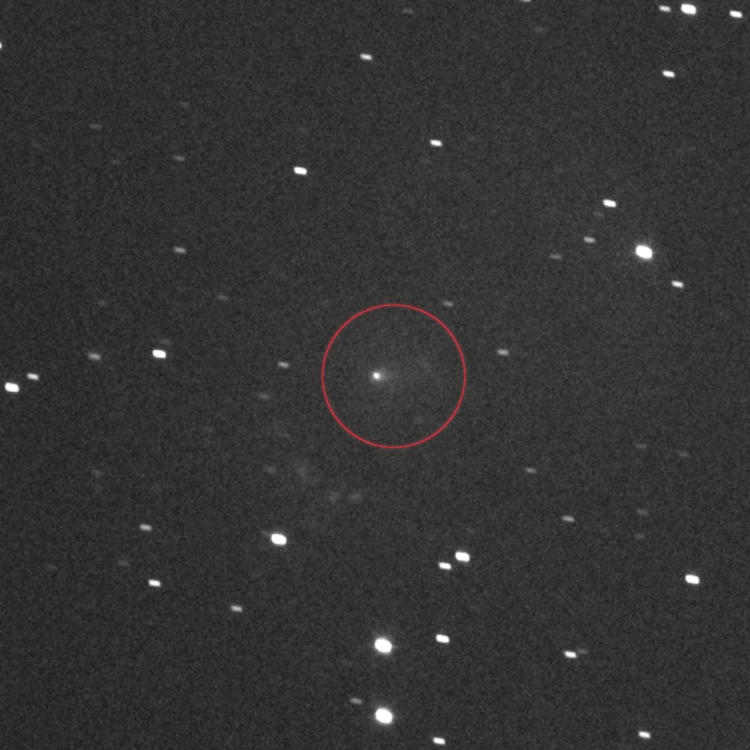
Interest in 3I/ATLAS has grown in part because of its unusual features. Researchers have pointed to its narrow anti-tail jet and its behavior as it exited the inner solar system as departures from patterns seen in long-period comets bound to the Sun. Loeb has argued that these features, along with the puzzling acceleration observed in earlier interstellar visitor 1I/'Oumuamua, warrant examination as potential indicators of unfamiliar physical processes.
In earlier commentary, Loeb described Earth's brief encounter with 3I/ATLAS as a "message in a bottle," adding that humanity was not the intended recipient of that cosmic passage. The forthcoming Jupiter flyby, he has suggested, could shift attention away from Earth and toward the massive planet as a more revealing stage for observing how interstellar material behaves under extreme gravitational stress.
The scientific questions are concrete, if speculative. Researchers will be watching for signs of fragmentation, unexpected outgassing, or trajectory deviations that could hint at structural or compositional properties unlike those of native solar-system comets. Any such observations would be assessed against existing models of volatile ice behavior and tidal stress.
Loeb has framed the broader effort as a step toward what he calls interstellar archaeology, an approach that treats visiting objects as physical records of distant star-forming environments. The Jupiter flyby, he has argued, could function as a pilot case for studying such relics under controlled gravitational conditions.