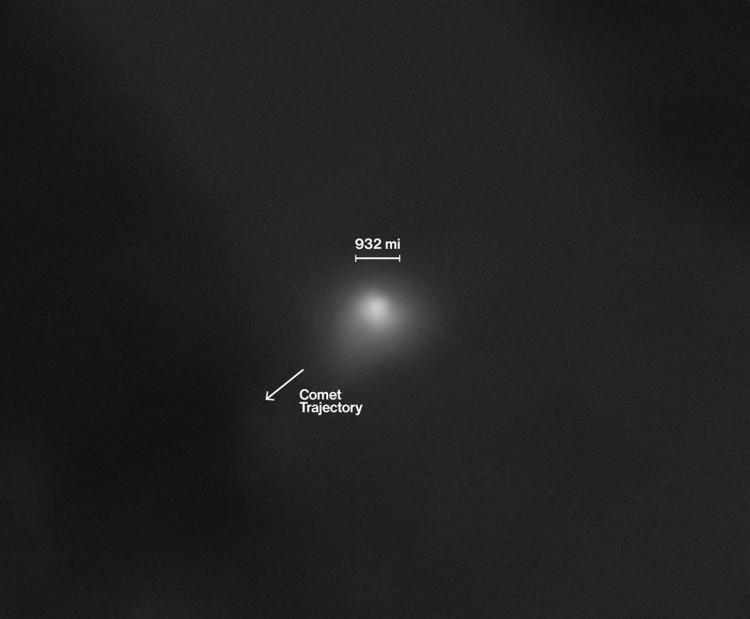
(Photo: NASA/JPL-Caltech/University of Arizona)
The discovery of the interstellar object known as 3I/ATLAS has reignited debate among astronomers after new observations suggested behavior that some researchers say cannot be easily explained by conventional comet physics. First detected on July 1, 2025, by the NASA-funded Asteroid Terrestrial-impact Last Alert System in Chile, the object is only the third confirmed visitor from outside the solar system, following 1I/'Oumuamua and 2I/Borisov.
The object drew intensified scrutiny after data from the Hubble Space Telescope revealed complex jet activity as it passed through the inner solar system. Observations taken in late December showed a persistent, structured "anti-tail" pointing toward the Sun, a feature that has become central to an increasingly polarizing scientific debate.
Harvard astrophysicist Avi Loeb, who previously argued that 1I/'Oumuamua may have been artificial in origin, has again challenged conventional interpretations. Writing in his analysis, Loeb said the new data raise questions about whether 3I/ATLAS behaves like a typical comet. "Interestingly, this is roughly the traverse radius of the glowing halo (coma) around the nucleus of 3I/ATLAS," he wrote, referring to measurements of the object's emissions.
The object passed its closest point to Earth on Dec. 19, 2025, at a distance of roughly 1.8 astronomical units, or about 170 million miles. Astronomers estimate the nucleus to be between roughly 440 meters and 5.6 kilometers wide, traveling at a hyperbolic excess velocity of about 58 kilometers per second, making it the fastest interstellar object yet detected.
According to Loeb, standard comet physics would predict a different behavior. "If it is a natural comet," he wrote, "then the anti-tail jet should not include streaming gas beyond a distance of 5,000 kilometres from the nucleus." He added that "at distances much larger... the anti-tail should be composed primarily of a stream of 10-micron dust particles."
Instead, high-resolution imagery suggests sustained, structured emissions that appear inconsistent with simple sublimation models. The symmetry of the jets and their persistence over time have drawn particular attention, especially because solar radiation pressure would normally disrupt such patterns.
Loeb has argued that chemical diagnostics could resolve the issue. He has called for targeted observations using facilities such as the James Webb Space Telescope and the Keck Observatory to trace molecular signatures along the jet axis. He wrote that identifying specific gases could determine whether the emissions align with natural outgassing or something else.
Referring to his diagnostic framework, Loeb invoked what he described as a "Duck Test" approach, arguing that classification should depend on measurable physical behavior rather than assumptions. He noted that anomalously high concentrations of metals, including nickel, reported in early spectral readings warrant closer scrutiny.
"If it is a natural comet," Loeb wrote, "then the anti-tail jet should not include streaming gas beyond a distance of 5,000 kilometres from the nucleus." He added that departures from this expectation would challenge standard comet models and require alternative explanations.
The object's trajectory has also attracted attention. After approaching Earth from the direction of Sagittarius, 3I/ATLAS passed relatively close to Mars on Oct. 3, 2025, before continuing outward. Loeb has suggested that this geometry could be significant, noting that its path appears unusually well-aligned for observational encounters.