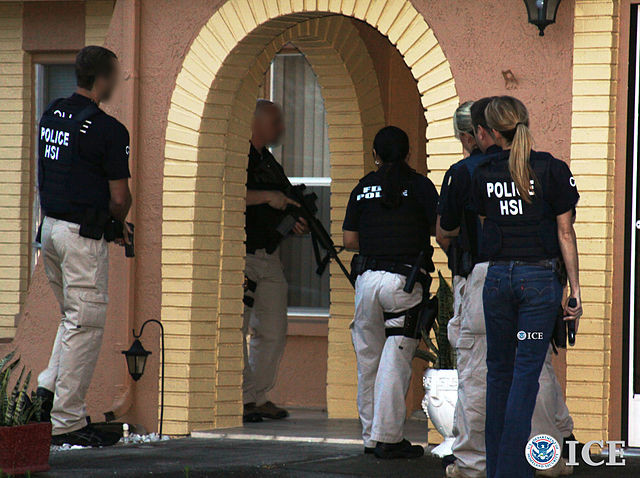
An internal directive issued this week by Immigration and Customs Enforcement is reshaping how immigration arrests are carried out across the United States, sharply expanding agents' authority to detain people without warrants during enforcement operations. The memo, reviewed by The New York Times, signals a decisive shift toward on-the-spot arrests with minimal judicial oversight, raising alarms among former officials and legal experts.
Signed by Todd M. Lyons, ICE's acting director, the guidance reinterprets federal law governing warrantless arrests. It directs officers to apply a far broader definition of when an individual is "likely to escape," a standard that historically limited such arrests to cases involving specific targets or clear flight risks.
Mr. Lyons criticized the prior interpretation as "unreasonable" and "incorrect." In the memo, he wrote: "An alien is 'likely to escape' if an immigration officer determines he or she is unlikely to be located at the scene of the encounter or another clearly identifiable location once an administrative warrant is obtained."
The practical effect is a lower threshold for detention. Rather than assessing whether a person would evade future court proceedings, agents are instructed to focus on whether someone might simply leave the immediate area before paperwork can be completed. That change, critics say, effectively sidelines the warrant requirement.
Claire Trickler-McNulty, a former senior adviser at ICE during the Biden administration, described the new standard as "an extremely broad interpretation of the term 'escape.'" She warned: "It would cover essentially anyone they want to arrest without a warrant, making the general premise of ever getting a warrant pointless."
The memo outlines factors agents may consider when making these snap decisions, including whether a person has access to a vehicle, provides "unverifiable or suspected false information," or possesses documents the officer believes may be fraudulent. Civil liberties advocates argue such criteria are subjective and invite indiscriminate enforcement.
Particularly vulnerable under the new guidance are so-called "collateral aliens"-individuals who are not the intended targets of an operation but happen to be nearby. Under the memo, agents may detain these bystanders if they believe the individuals could leave the scene, transforming targeted raids into broader sweeps.
Scott Shuchart, a former head of policy at ICE, said the directive "bends over backwards to say that ICE agents have nothing but green lights to make an arrest without even a supervisor's approval." Reports have already surfaced of enforcement actions in public spaces, including hardware store parking lots, where bystanders were questioned or detained.
The timing of the memo has intensified scrutiny. It follows fatal shootings involving federal agents during immigration operations in Minneapolis, incidents that have fueled public protests and calls for restraint. While President Donald Trump said recently that enforcement would "de-escalate a little bit," the expanded arrest authority points in the opposite direction.
The guidance also appears to weaken earlier protections. A 2022 settlement required agents to weigh "ties to the community" before making arrests, but Mr. Lyons argued such assessments are often impossible during "on-the-spot" encounters. He wrote that officers frequently act with "limited information about the subject's identity, background or place of residence."
The Department of Homeland Security has said the policy is not new and amounts to a clarification, emphasizing record-keeping requirements. Former officials counter that the lowered threshold fundamentally alters enforcement dynamics, expanding the risk that routine public encounters could end in detention for people who were never the focus of an investigation.