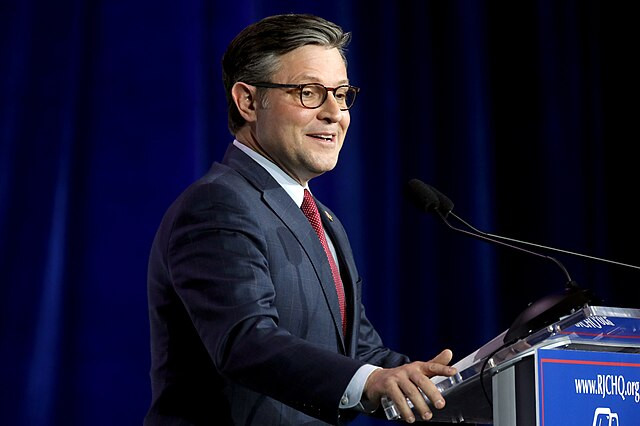
Mike Johnson has thrust the Bible into the center of the U.S. immigration debate, publicly disputing comments by Pope Leo XIV and arguing that strong national borders are not only lawful but consistent with Christian teaching, a claim that has intensified divisions between religious leaders and policymakers.
Speaking to reporters after a House vote, Johnson was asked about Pope Leo XIV's use of Scripture to criticize mass deportation policies. Johnson responded that "borders and walls are biblical," asserting that governments have a duty to enforce laws and preserve order. The exchange quickly spread online, drawing sharp reactions from faith leaders and political commentators.
Later the same day, Johnson expanded on his argument in a detailed post on X. "Despite the insistence of the progressive Left, people of all religious faiths should support a strong national border - and Christians certainly should," he wrote. He added that while compassion is a moral obligation for individuals, the responsibilities of government are different.
In the statement, Johnson leaned heavily on Scripture to argue that the Bible distinguishes between personal morality and state authority. "When Jesus taught us to turn the other cheek, He was not giving that command to the government," Johnson wrote, citing Romans 13, which describes civil authorities as agents tasked with maintaining order.
Johnson also pointed to passages that reference nations and boundaries, including Acts 17:26 and Deuteronomy 32:8, to support his view that borders are part of biblical tradition. "Immigration is not something that's frowned upon in Scripture," he said in remarks to reporters. "But assimilation is expected."
Pope Leo XIV has approached the issue from a markedly different theological angle. Speaking to journalists in November, the pontiff cited Matthew 25:35, saying, "For I was hungry and you gave me something to eat... I was a stranger and you invited me in." He warned that deportation policies are affecting migrants who have lived peacefully in the United States for years.
"Many times they've been separated from their families... no one knows what's happening," Pope Leo XIV said. "Their spiritual needs should be attended to." Rather than focusing on border enforcement, the Pope has emphasized pastoral care, humanitarian concerns and access to religious services for migrants.
Biblical texts frequently invoked in immigration debates cut in multiple directions. Verses emphasizing hospitality include "Do not mistreat an alien or oppress him" (Exodus 22:21) and "Love the foreigner, for you were foreigners in Egypt" (Deuteronomy 10:19). Other passages stress legal order, such as "Everyone must submit himself to the governing authorities" (Romans 13:1).
A summary published by Watermark Community Church reflects that tension, stating, "We should love the immigrant but not ignore immigration laws." The framing underscores how Scripture is often used to support both compassion and enforcement.
Johnson's remarks arrive amid renewed political fights over immigration tied to policies under both the Trump and Biden administrations. He has repeatedly criticized what he describes as "open border" approaches, claiming, "We had as many as 20 million illegals come across the country," and arguing that protecting citizens must come first.
At its core, the dispute highlights a broader question about how religious teachings should guide modern governance. Johnson insists that "justice and mercy are not mutually exclusive," while Pope Leo XIV has urged leaders to weigh the human cost of enforcement. Both cite Scripture, yet their sharply different conclusions continue to shape an increasingly polarized debate over faith, borders and public policy.