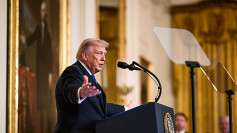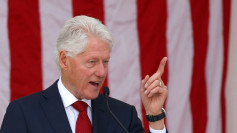
Former President Bill Clinton used his sworn testimony before the House Oversight Committee to defend his wife, Hillary Clinton, criticize Republicans for subpoenaing her, and recount a previously unpublicized conversation with President Donald Trump about Jeffrey Epstein.
Clinton, who testified for more than four hours in late February, said lawmakers were right to question him about his past association with Epstein but objected to compelling Hillary Clinton's appearance based on what he described as minimal contact.
"So I don't think that was right," Clinton said of the subpoena targeting his wife. Referring to a single photograph of the couple shaking Epstein's hand at a 1993 White House event, he added: "I do think you should be talking to me. I did take those plane trips with him."
The deposition, released publicly by the committee on Monday, marks the first time since 1983 that a former president has been compelled to testify before Congress. Bill Clinton's session lasted 4 hours 33 minutes; Hillary Clinton's, the day before, ran 4 hours 35 minutes.
During his testimony, Clinton described a golf course encounter with Trump roughly two decades ago at a Joe Torre Safe at Home Foundation charity tournament. Trump, Clinton said, referenced his past relationship with Epstein.
"You know, we had some great times together over the years, but we fell out all because of a real estate deal," Clinton testified that Trump told him. "And he said, 'I'm sorry it happened.'"
Clinton emphasized that Trump "never said anything to make me think he was involved with anything improper," before adding: "That's for you to decide."
The account contrasts with statements from the White House last November, when Press Secretary Karoline Leavitt said Trump "kicked [Epstein] out" of Mar-a-Lago because "Jeffrey Epstein was a paedophile and he was a creep."
Hillary Clinton, asked whether Trump should be called to testify, responded directly: "Absolutely. He would be on my witness list."
Rep. Robert Garcia (D., Calif.), the committee's top Democrat, seized on the release of the videos to press for Trump's testimony. "Republicans have now set a new precedent, which is to bring in presidents and former presidents to testify," Garcia said. "We now want President Trump to come in and to testify under oath." Garcia argued that Trump appears in the Epstein files "almost more than anyone else besides Ghislaine Maxwell."
Committee Chairman James Comer countered that sitting presidents cannot be deposed. Trump told reporters, "I don't like seeing him deposed, but they certainly went after me a lot more than that."
The depositions were marked by procedural friction. According to reports, Rep. Lauren Boebert shared photographs from the closed-door sessions with conservative influencer Benny Johnson, who posted them online. After Bill Clinton's testimony, Boebert referenced Hillary Clinton's 2013 Benghazi testimony with the caption: "What difference, at this point, does it make?"
Hillary Clinton reacted sharply upon learning of the leak. "I'm done with this. If you guys are doing that, I am done," she said, striking the table. "You can hold me in contempt from now until the cows come home." She later criticized lawmakers for asking about "UFOs and a series of questions about Pizzagate, one of the most vile, bogus conspiracy theories that was propagated on the internet."
Throughout his testimony, Bill Clinton reiterated that he never visited Epstein's private island, never witnessed misconduct, and ended contact with Epstein years before his 2008 Florida conviction for soliciting prostitution from an underage girl. He acknowledged flying on Epstein's plane more than a dozen times between 2001 and 2004 for Clinton Foundation work.
Hillary Clinton said she did not recall meeting Epstein and described knowing Ghislaine Maxwell, now serving a 20-year sentence for sex trafficking, "casually as an acquaintance."
Neither Bill Clinton nor Hillary Clinton has been charged with wrongdoing in connection with Epstein. Nor has Trump. But with nearly nine hours of sworn testimony now public, the investigation has shifted from quiet depositions to a widening political contest over who else may be called to answer questions under oath.