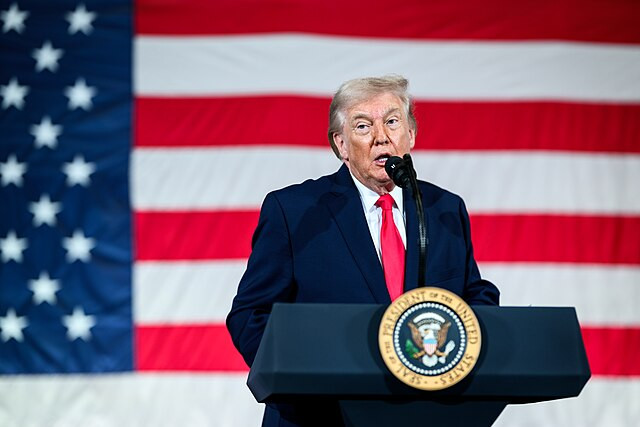
President Donald Trump is facing sharp criticism from press-freedom advocates, legal scholars and political opponents after suggesting that journalists covering the ongoing Iran war could face "charges for treason," a crime that under U.S. law can carry the death penalty.
Trump's remarks came during escalating tensions over media coverage of the conflict involving the United States, Israel and Iran, which began in late February 2026 and has become a dominant geopolitical issue in Washington and across international news outlets.
The president argued that some Western media organizations had helped circulate Iranian propaganda and manipulated imagery related to the conflict.
In a series of statements, Trump accused certain outlets of repeating what he described as artificial-intelligence-generated disinformation produced by Iranian sources. He said organizations spreading such material should face "charges for treason," asserting that the reporting undermined American national interests.
Trump also praised Federal Communications Commission Chairman Brendan Carr for reviewing whether broadcast licenses could be examined in response to what the president described as "unpatriotic" coverage.
The comments quickly triggered a backlash from media watchdog groups and legal experts who said the rhetoric risks threatening constitutional protections for journalists.
Under Article III of the United States Constitution, treason is narrowly defined as "levying war" against the United States or "adhering to their enemies, giving them aid and comfort."
Federal law codified in 18 U.S. Code §2381 specifies the penalties for conviction:
- Death penalty or imprisonment of at least five years
- Fines under federal sentencing rules
- Disqualification from holding public office
Legal scholars emphasize that the evidentiary threshold for treason prosecutions is extremely high. The Constitution requires either a confession in open court or testimony from two witnesses to the same overt act.
Historically, prosecutions for treason have been rare and largely confined to wartime collaboration with enemy governments.
One notable example occurred after World War II, when American broadcaster Robert Henry Best was convicted for delivering Nazi propaganda broadcasts from Germany during the war.
Experts note that routine journalistic reporting-even if controversial or inaccurate-generally does not meet the constitutional definition of treason unless it intentionally provides material assistance to an enemy power.
Press-freedom organizations warned that accusing journalists of treason could undermine the role of the First Amendment, which protects freedom of the press.
Critics also pointed to Trump's long-standing confrontations with major media organizations.
During earlier political campaigns and throughout his presidency, Trump frequently described journalists as "the enemy of the people," accusing outlets of spreading false or politically motivated narratives about his administration.
The latest dispute is unfolding amid a broader information battle surrounding the Iran conflict.
Officials in Washington and Tehran have both accused the other side of spreading misinformation online, including manipulated images and videos claiming military victories or large public demonstrations.
Fact-checking organizations and independent journalists have confirmed that AI-generated media and edited footage have circulated widely on social platforms during the conflict. Analysts say such material can quickly influence public perception even when the underlying events remain uncertain.