Donald Trump sought to distance the United States from Israel's strike on Iran's South Pars gas field, saying Washington "knew nothing about this particular attack," even as conflicting reports suggested prior awareness and support, deepening uncertainty among allies and rattling global energy markets.
The strike on the South Pars field-one of the world's largest natural gas reserves-triggered a chain reaction across the Gulf, with Iran launching retaliatory threats and missile activity targeting regional energy infrastructure, including facilities in Qatar and Saudi Arabia.
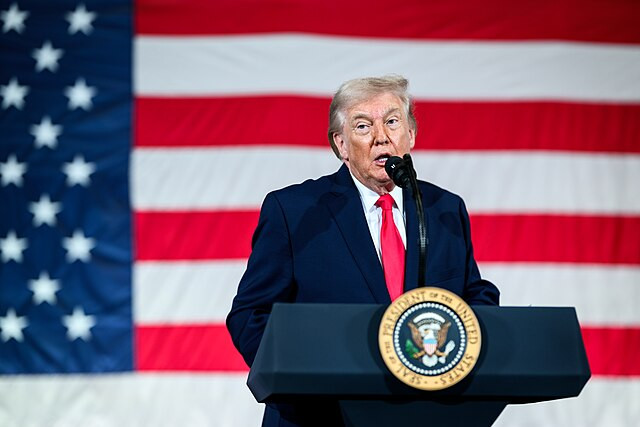
Trump, posting on Truth Social, emphasized that the United States was not involved in the operation and attempted to reassure regional partners. He said the U.S. "knew nothing about this particular attack," adding that Qatar "was in no way, shape, or form, involved with it, nor did it have any idea that it was going to happen."
The president described Israel's move as having "violently lashed out," signaling an effort to frame the strike as unilateral. He also indicated that further escalation could be avoided, saying there would be no additional attacks unless Iran retaliated, according to Reuters.
However, that account was complicated by reporting from The Wall Street Journal, which cited sources indicating Trump had advance knowledge of the operation. According to the report, "Trump, who knew about the Israeli strike on South Pars in advance, supported it as a message to Tehran over its block of the Strait of Hormuz," as quoted by Al Jazeera.
The Journal report added, "The president believes Iran got the message and is now against attacks on Iranian energy infrastructure," highlighting a divergence between public statements and reported internal positioning.
The contradiction has intensified scrutiny of U.S. policy in the region, particularly as the conflict expands beyond military targets to critical energy assets. Analysts say such ambiguity complicates diplomatic efforts and undermines confidence among Gulf allies.
Iran's response has already widened the conflict footprint. Missile launches toward Qatar struck infrastructure linked to QatarEnergy, which reported "significant damage" at Ras Laffan Industrial City, a hub responsible for roughly 20% of global LNG supply.
Saudi Arabia reported intercepting four ballistic missiles aimed at Riyadh and neutralizing a drone targeting a gas facility in its eastern region. Additional missile activity followed, underscoring the risk of sustained escalation across the Gulf's energy network.
The targeting of energy infrastructure marks a strategic shift in the conflict, with economic assets now functioning as primary pressure points. The attacks have driven oil and gas prices higher and injected volatility into global markets already sensitive to supply disruptions.
In Washington, the situation has intersected with domestic political tensions. According to The Guardian, Senate Republicans blocked a measure aimed at limiting the president's authority to engage militarily with Iran without congressional approval, raising concerns about oversight as the crisis evolves.
Critics have pointed to what they describe as inconsistent messaging from the administration. Observers cited by The Atlantic argue that the president's approach reflects a pattern of reactive decision-making rather than long-term strategic planning, particularly in complex geopolitical environments.
For Gulf states, the immediate challenge is deciphering Washington's position. Trump's public effort to create distance from Israel's actions contrasts with reports of prior coordination, leaving allies uncertain whether U.S. policy reflects disengagement or strategic ambiguity.