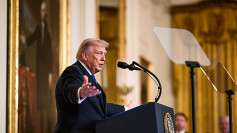
Donald Trump is facing criticism after a White House event intended to promote youth fitness turned into an online flashpoint when the president questioned a young girl's volleyball ambitions based on her height and later pivoted into remarks about Iran while speaking before children gathered in the Oval Office.
The exchange occurred during a ceremony celebrating the reinstatement of the Presidential Fitness Test Award, a program designed to encourage physical activity among school-aged Americans through standardized fitness benchmarks including running, push-ups and sit-ups.
What was meant to be a largely celebratory event instead generated viral clips that spread rapidly across social media, fueling debate over Trump's tone and his interactions with children in public settings.
During one exchange inside the Oval Office, Trump asked a girl about her athletic interests. She replied: "I play volleyball and in the summer I'm trying to get into soccer."
Trump immediately focused on her physical stature. "And with your height do you smash the volleyball. Can you get up high. Can you jump high," he asked.
When the girl answered, "Not very," Trump responded: "Soccer might be better."
Moments later, he added: "I think she'd be a great soccer player. That's good, good luck, okay."
The clip quickly circulated online, where critics accused the president of discouraging the child and reducing her athletic aspirations to a conversation about height. Others defended the exchange as casual humor and argued Trump was simply speaking bluntly in an informal setting.
One social media user wrote: "Why does he have to mock this little girl's height." Another took a different view, posting: "Call him what you will he's funny."
The debate overshadowed much of the broader event, which featured athletes and public figures tied to the administration's renewed emphasis on youth athletics and physical conditioning. Among those attending were Bryson DeChambeau, Gary Player, Amani Oruwariye and Noah Syndergaard.
Members of the President's Council on Sports, Fitness, and Nutrition also participated in the event, which the White House framed as part of a larger push to combat declining youth fitness levels in the United States.
But the ceremony became increasingly politically charged as Trump drifted into broader subjects beyond athletics. At one point, speaking in front of children clustered around him, the president turned to Iran and nuclear weapons.
"We can't let Iran have a nuclear weapon," Trump said. "You might be too young for this."
The remarks came amid heightened tensions between Washington and Tehran and followed several weeks of increasingly forceful rhetoric from the administration regarding Iran's nuclear capabilities and regional military posture.
Some observers questioned whether the geopolitical discussion was appropriate for a room filled with elementary and middle-school-aged children. Video footage from the event showed several children appearing distracted or disengaged as Trump continued speaking.
The controversy added to a growing pattern in which informal Trump remarks at public events quickly become viral political moments. Trump's supporters have long viewed his unscripted speaking style as evidence of authenticity, while critics argue the same bluntness can appear dismissive or insensitive, particularly in interactions involving children.
The Presidential Fitness Test itself carries symbolic weight for older Americans who remember the Cold War-era program as a staple of public-school life. The initiative, originally introduced in the 1950s, became associated with national concerns over youth health, military readiness and physical education standards before being phased out in recent years.