Donald Trump and Iranian officials issued sharply conflicting statements over the status of the Strait of Hormuz on April 18, exposing a widening gap between Washington's claims of a breakthrough and Tehran's insistence that it retains tight control over one of the world's most critical energy corridors.
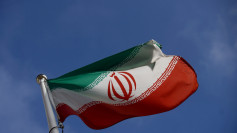
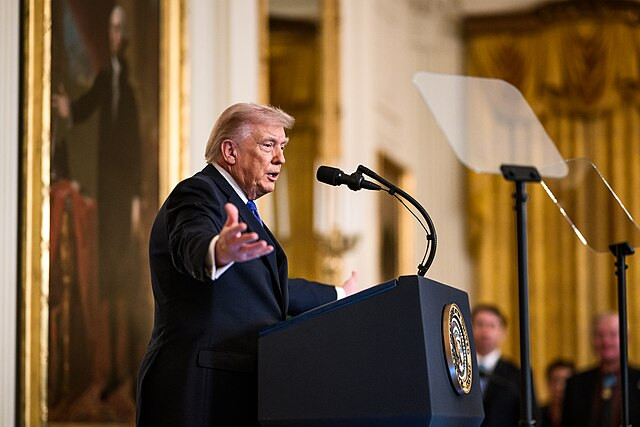
The dispute unfolded within hours. Trump declared on his Truth Social platform that "Iran has agreed to never close the Strait of Hormuz again. It will no longer be used as a weapon against the world." Shortly afterward, Iran's joint military command countered that "control of the Strait of Hormuz has returned to its previous state ... under strict management and control of the armed forces."
The rapid reversal underscored the absence of any verifiable agreement between the two sides. No joint communiqué, treaty text, or independent confirmation has emerged to support Trump's assertion, while Iranian officials have publicly articulated a position that directly contradicts it.
Tehran's stance appears closely tied to ongoing U.S. pressure. The White House has maintained a blockade on Iranian ports, which Trump reiterated would remain "in full force" until broader negotiations-particularly over Iran's nuclear program-are completed. Iranian officials have framed their control of the Strait as a reciprocal measure tied to those restrictions.
Ebrahim Azizi outlined a more restrictive operational framework for maritime traffic. He said only vessels authorized by the Islamic Revolutionary Guard Corps Navy would be permitted to transit and must comply with "required tolls," adding: "The time has come to comply with a new maritime regime for the Strait of Hormuz."
Azizi also issued a warning that "if the US attempts to create any disturbance for Iranian ships this situation can be easily changed," signaling that Tehran views the waterway as leverage rather than a neutral passageway under current geopolitical conditions.
The divergence in messaging has broader implications for global energy markets and diplomatic alignment. Trump's framing of a near-term reopening suggested a de-escalation that could stabilize oil flows, while Iran's statement indicates continued constraints and potential costs for shipping companies navigating the route.
The episode has also drawn in Xi Jinping, whom both sides cited as a beneficiary-or even a supporter-of their respective narratives. Trump wrote that "President Xi is very happy that the Strait of Hormuz is open and/or rapidly opening," while Azizi similarly claimed to have pleased the Chinese leader with earlier developments.
Neither Beijing nor Chinese state media has issued a public confirmation of those claims, leaving both statements unverified and highlighting the extent to which global powers are being invoked rhetorically in the dispute.