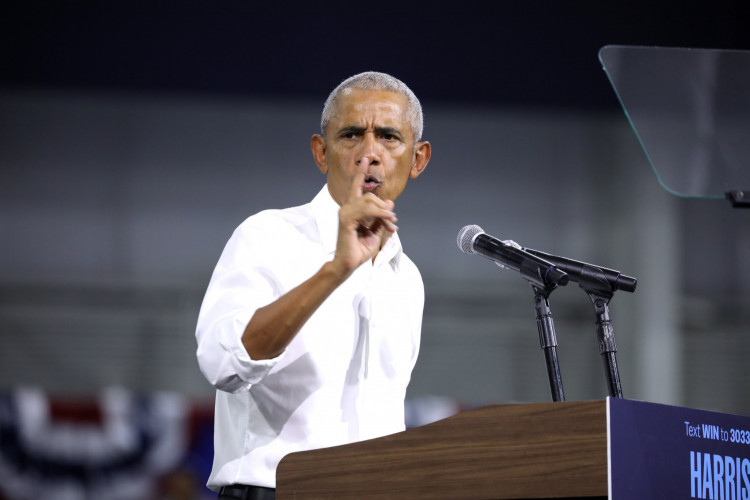
Barack Obama intended this week's announcement about the long-awaited Obama Presidential Center opening to showcase a landmark cultural investment in Chicago's South Side. Instead, the $850 million project immediately reignited years of political, architectural and financial criticism - this time fueled by a photo identification requirement tied to discounted admissions.
The former president announced Wednesday that the center would officially open to the public on June 19, inviting visitors to tour the museum campus, a new branch of the Chicago Public Library, gardens, playgrounds and community spaces built inside Chicago's historic Jackson Park.
But within hours of tickets going on sale, conservative commentators and Republican lawmakers seized on one particular detail in the admissions policy: Illinois residents seeking free Tuesday admission or reduced-price tickets must present valid government-issued photo identification.
The requirement quickly became ammunition in the broader national fight over voter identification laws.
Republicans pointed to Obama's earlier criticism of stricter federal voter ID proposals, including the SAVE America Act debated in Congress this year, arguing the policy exposed a contradiction between Democratic opposition to voter identification requirements at polling places and support for ID verification at cultural institutions.
Kayleigh McEnany and Brandon Gill were among conservatives publicly highlighting the issue online. Social media criticism escalated rapidly, with users mocking the building's appearance and labeling the structure the "Obamalisk" and "dildo building," while others described the project as an "indoctrination factory."
Supporters of the center argued the comparison fundamentally distorts the issue.
Museums, sports arenas and public attractions routinely require identification for residency verification or discounted pricing, they noted, while voting rights advocates maintain that ballot access involves constitutional protections and historical discrimination concerns not comparable to ticketing policies.
The admissions controversy, however, landed atop years of preexisting criticism surrounding the Obama Presidential Center itself.
The privately funded complex occupies roughly 20 acres inside Jackson Park near Lake Michigan, an area designed by famed landscape architect Frederick Law Olmsted, whose work also shaped New York's Central Park.
Opponents of the project have long argued the development transformed historically protected public parkland into what some critics view as an oversized monument to Obama himself.
Architectural historian W. J. T. Mitchell previously described the structure as a "cenotaph" and a "crusader fortress in brutalist style." Other critics have been considerably less restrained, attacking the appearance of the 240-foot tower as visually oppressive and out of scale with the surrounding park.
The project's costs have also ballooned dramatically.
What began as an estimated $300 million undertaking has now climbed to approximately $850 million, according to figures associated with the development.
Critics additionally note that while the center is privately financed through the Obama Foundation, Chicago taxpayers have still absorbed infrastructure expenses tied to road redesigns, traffic changes and surrounding redevelopment projects.
Questions have also emerged about long-term operating costs and sustainability:
- Estimated annual operating expenses reportedly approach $30 million.
- Obama presidential archives will not permanently reside at the center because federal presidential library regulations impose size restrictions the complex exceeds.
- Digital archives are expected to replace large portions of traditional document storage.
The handling of Jackson Park itself has become another focal point of opposition.
Critics say thousands of trees were removed during construction and point to the demolition of the historic Women's Garden, originally created during the 1930s to honor pioneering architect Sophia Hayden.
Grahm Balkany, a politically progressive architect quoted previously by the New York Post, criticized the symbolism of the project itself.
"Obama, of all people, should not be building a palace for himself," Balkany said.
The Obama Foundation has consistently defended the development as a major economic and cultural investment in Chicago's South Side, arguing the project will create jobs, expand public programming and improve flood management and recreational access throughout Jackson Park.
Foundation officials also reject suggestions the center functions primarily as a personal monument, describing it instead as a civic campus designed around education, leadership development and public engagement.