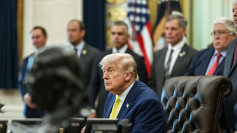
Donald Trump is pushing back against mounting online speculation about his health after viral videos showing him carefully descending the steps of Air Force One fueled fresh commentary about his mobility, age and mental fitness.
Speaking this week on Dan Bongino's radio show, Trump said his increasingly slow and deliberate movements are intentional, explaining that he wants to avoid a public fall similar to the one that haunted Joe Biden throughout his presidency.
"I'm very careful when I walk, by the way, because if I ever fall... the fake news... they're going to have... that headline will go on for years," Trump said during the interview.
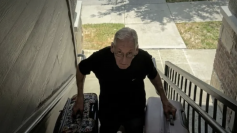
The remarks came after months of heightened scrutiny surrounding the 79-year-old president's physical movements. Since late 2025, short video clips circulating online have shown Trump gripping handrails tightly while exiting Air Force One, taking shorter steps and occasionally appearing to walk with a slightly uneven or "zigzag" gait.
Those clips, widely reshared across social media platforms, have prompted speculation ranging from ordinary age-related caution to unsupported claims about cognitive decline or dementia. No official diagnosis suggesting neurological impairment has been made public.
Trump framed his slower pace not as weakness, but as calculated caution. "You know, sometimes, like I walk out of the plane... I'm not looking to set any records. You go nice and easy," he said. In another moment, he joked: "Ever noticed how slowly I am these days? Nice and slowly, I'm not looking to set any records. You don't wanna go down. Could happen, could happen."
The president repeatedly returned to Biden's widely replayed March 2021 stumble on the Air Force One staircase, an incident that became a defining visual in debates about presidential age and fitness.
"Our country was laughed at, disrespected. Our president was disrespected," Trump said while recalling the episode. "He couldn't walk without falling down the d--- stairs."
At the same time, Trump insisted he did not personally enjoy watching the incident unfold. "Some people thought it was funny," he said. "I didn't like it. I didn't like watching it. (He) should have never been there."
The comments highlight how physical appearance and visible aging have become central political vulnerabilities in modern presidential campaigns, particularly as both Trump and Biden entered office at historically advanced ages.
Trump's own movements have increasingly become a subject of frame-by-frame analysis online following a minor stumble in mid-2025 that circulated widely across social media. Since then, critics have repeatedly pointed to footage showing him walking more cautiously, particularly on staircases and ramps.
Observers have also noted that Trump frequently opts for shorter rear stairways on Air Force One rather than the larger front staircase often used during ceremonial arrivals. White House aides have not publicly commented on whether the choice reflects logistical convenience or physical comfort.
Medical experts quoted in broader media coverage have urged caution about drawing sweeping conclusions from isolated video clips. Some clinicians observing publicly available footage have described Trump's gait as possibly "wide-based" or uneven, but no physician has publicly linked his movements to dementia or another specific neurological condition.
The absence of verified medical evidence has done little to slow online speculation, particularly in an election environment where questions surrounding age and vitality have become politically explosive. Trump spent years using Biden's physical stumbles and verbal missteps as shorthand for presidential decline, only to find himself subjected to the same relentless visual scrutiny as he approaches his 80th birthday next month.