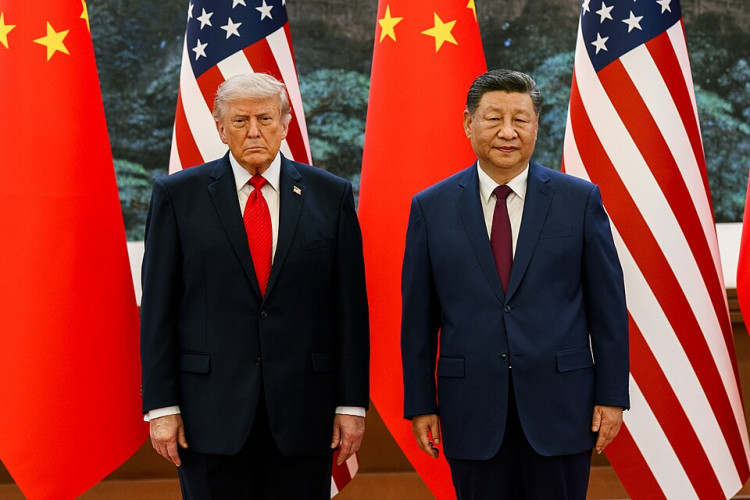
Donald Trump publicly brushed aside an offer from Xi Jinping to help mediate tensions surrounding Iran, underscoring the fragile state of U.S.-China diplomacy even after the two leaders spent days in Beijing discussing trade, Taiwan and the escalating crisis in the Middle East.
The remarks came after Trump concluded high-level meetings in Beijing, where Iran's nuclear ambitions and instability in the Strait of Hormuz emerged as central topics alongside economic disputes between the world's two largest economies. While both sides attempted to project cooperation during the summit, Trump's response to Xi's diplomatic overture highlighted how little strategic trust exists beneath the ceremonial optics.
According to Trump's post-summit comments carried by Fox News, Xi offered to help ease tensions involving Tehran and support efforts to stabilize shipping through the Strait of Hormuz, a narrow waterway that remains one of the most critical arteries for global oil supplies.
Trump acknowledged the proposal but suggested Washington did not require outside assistance to manage the conflict.
The president also said Xi pledged China would avoid supplying military equipment to Iran, a statement that drew attention because Beijing remains one of Tehran's most significant economic partners and a major purchaser of Iranian energy exports.
Despite that assurance, Trump signaled he had little appetite for expanding China's diplomatic role in the region.
The exchange arrives at a delicate moment for global markets. Oil prices have climbed in recent weeks amid fears that disruptions in the Strait of Hormuz could threaten international energy shipments. Analysts have warned that even temporary instability in the corridor could reverberate across fuel prices, shipping costs and inflation-sensitive sectors worldwide.
The Strait of Hormuz handles a substantial portion of global crude exports, making every military or diplomatic development involving Iran closely watched by traders and governments alike.
Beijing has increasingly attempted to present itself as a stabilizing geopolitical actor during international crises, particularly in regions where the United States traditionally dominated diplomacy. China previously brokered a rapprochement between Iran and Saudi Arabia, and Xi's latest offer appeared consistent with Beijing's broader effort to expand its influence in conflict mediation.
Yun Sun, director of the China Program at the Stimson Center, described Beijing's priorities in comments cited by The Washington Post.
"China's primary goal is to aim for stability of the relationship: 'Please don't bother us. Please don't harass us. ... And let's find some rules of engagement that will allow us to proceed in relative peace and relative stability,'" Sun said.
Still, the Beijing summit produced few concrete breakthroughs beyond carefully staged displays of cordiality.
Chinese officials framed the talks as an effort to preserve "strategic stability" between Washington and Beijing, but public readouts from both governments differed on several key issues, including Taiwan and regional security. Analysts noted that the divergence reflected continuing friction despite the diplomatic choreography surrounding Trump's visit.
Trump, meanwhile, has maintained an aggressive posture toward Tehran throughout the crisis.
In recent remarks, he warned that "the clock is ticking" for Iran to reach a deal over its nuclear program, while continuing to pressure Tehran over uranium enrichment and regional military activity. Negotiations between Washington and Iran remain stalled over sanctions relief, verification measures and long-term security guarantees.
The Iran issue has also become entangled with wider U.S.-China competition. Washington increasingly views Beijing's growing ties with Tehran through a strategic lens, particularly as China deepens energy, trade and infrastructure relationships across the Middle East.
At the same time, Chinese leaders appear eager to avoid direct confrontation with the United States while protecting economic interests tied to Gulf stability and uninterrupted oil flows.