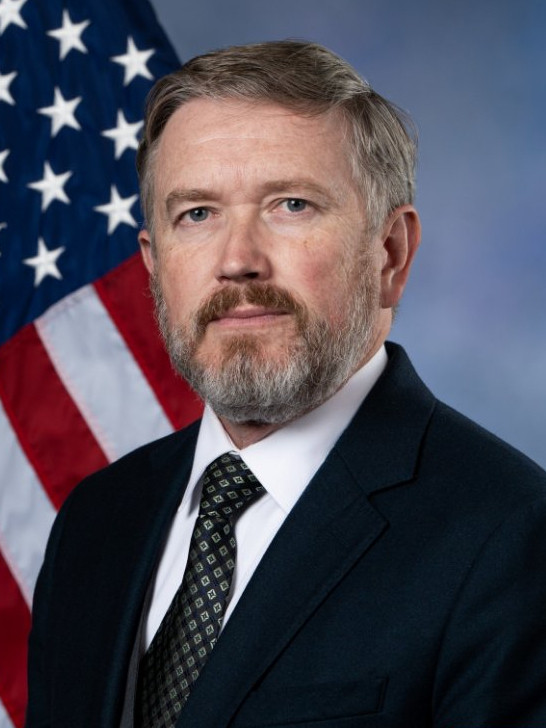
Donald Trump tightened his grip on the Republican Party after longtime Kentucky congressman Thomas Massie lost a bruising GOP primary that many Republicans now describe as a warning to conservatives unwilling to fully align with Trump's political movement.
The race, centered in Kentucky and fueled by millions of dollars in outside spending, ended with Trump-backed challenger Ed Gallrein leading with 54.8% of the vote to Massie's 45.2%, according to Associated Press figures cited by The Wall Street Journal. The contest rapidly evolved from a standard congressional primary into a national proxy battle over loyalty inside today's Republican Party.
Massie, a libertarian-minded conservative known for opposing government spending packages, foreign intervention and surveillance programs, had spent years positioning himself as one of the few Republicans willing to publicly challenge Trump-aligned priorities. That independence increasingly placed him at odds with a party apparatus now heavily shaped by Trump's influence.
Republican strategist T.J. Litafik summarized the political reality bluntly in comments reported by Reuters: "Massie got Trumped. Donald Trump is the sun and the moon and the stars in the Republican Party in Kentucky."
The scale of the battle underscored how seriously Trump's orbit viewed the race. Political analysts described it as one of the most expensive House primaries in modern American politics, with heavy involvement from outside groups determined to remove one of the GOP's most visible internal dissenters.
Behind the financial firepower was a broader ideological message increasingly circulating inside Republican circles: disagreement with Trump may now carry a direct political cost, even for reliably conservative lawmakers.
Massie's supporters framed his defeat less as a rejection of his policies than as punishment for resisting Trump's authority. The phrase "refused to bend the knee" became a recurring description among Republican insiders analyzing the race and its implications for the future of the GOP.
A veteran Republican strategist speaking anonymously described the outcome as "a revenge tour" aimed at Republicans who refused to fully submit to Trump's political dominance.
"This was a revenge tour on a solid conservative vote who refused to break to the will of Trump," the strategist stated. "Thomas Massie refused to be compromised. He refused to bend the knee, and for that he was taken out."
Massie himself leaned into the image of ideological resistance during his post-election remarks. Speaking to supporters after the result became clear, he joked that he had to "call Tel Aviv" to get through to Gallrein, drawing laughter and chants from the crowd including "No more wars," "America First," and "2028."
"We weren't really running against Ed Gallrein. We weren't running against Donald Trump. We were running for what we believe in," Massie said, later adding that the result was "God's will."
The outcome also highlighted growing tensions within the MAGA coalition itself. While Trump's allies framed the victory as proof of party unity and discipline, critics inside conservative circles warned the GOP risks becoming increasingly intolerant of ideological independence.
Massie had long cultivated support among libertarian conservatives skeptical of foreign military involvement and large federal spending bills. His clashes with Republican leadership frequently involved constitutional objections rather than outright opposition to conservative goals, making him a unique figure inside the conference.