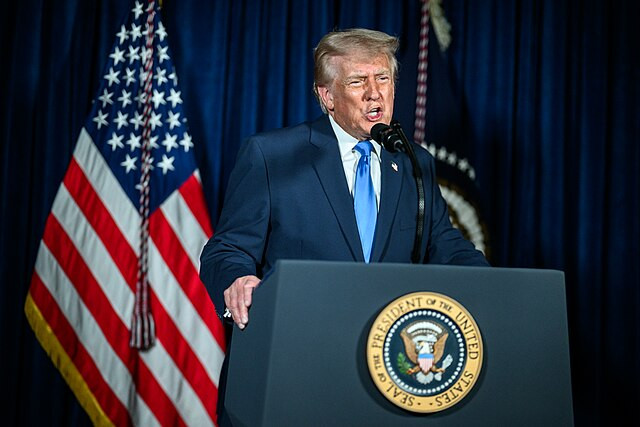
Donald Trump is pitching a planned $400 million White House ballroom as something far beyond a ceremonial venue, describing the proposed structure in Washington as a fortified complex equipped with missile resistance, drone defense systems and elevated sniper positions overlooking the nation's capital.
The remarks, delivered during a tour of the proposed site on Monday, immediately intensified debate surrounding the controversial project, which has already faced scrutiny in Congress over both its price tag and its use of taxpayer funding.
Trump told reporters the ballroom would be "drone-proof" and "missile-proof," while also functioning as a defensive hub with what he described as "great sniper capacity."
"Between the drone-proofing, missile-proofing, and drone capacity, we can have all sorts of military," Trump said. "I hate to use the word snipers, but we have great sniper capacity. It's built for our snipers, not the enemy's snipers."
The ballroom proposal had already become politically sensitive before Trump's latest comments. One day earlier, Senate Parliamentarian Elizabeth MacDonough ruled that Republican efforts to channel federal funding toward the project violated the Senate's Byrd Rule, which limits what can be included in fast-track budget legislation.
That ruling complicated Republican plans to secure hundreds of millions of dollars for the project through the reconciliation process, forcing lawmakers to consider alternative funding mechanisms or separate legislation.
Trump, however, framed the ballroom not as a luxury expansion but as a strategic security installation integrated into the broader protection of Washington.
Standing before reporters, the president described a structure with a heavily reinforced roof that would serve as an elevated surveillance and defense platform above the White House complex.
"Not only is it drone-proof, if a drone hits it, it bounces off. It won't have any impact," Trump said. "But it's also meant as a drone port, so it protects all of Washington, the roof of the building."
He added that the roof would be enclosed beneath what he called a glass "shield" approximately four inches thick. Trump did not provide engineering studies, architectural documents or technical evidence supporting the claims, and the White House has not released independent assessments regarding the building's proposed defensive capabilities.
The president also claimed the ballroom would sit atop a military-style infrastructure complex beneath the main structure. He did not specify whether that referred to bunkers, communications systems, security command facilities or personnel operations.
The lack of detail has fueled skepticism among both lawmakers and security analysts, particularly given the unusually martial language surrounding what was initially introduced as an expansion for state dinners and official receptions.
Social media reaction quickly turned mocking after clips of Trump's remarks circulated online.
One user wrote that Trump appeared to want "a golden dome in the form of a ballroom," while another described the proposal as "not a ballroom but a bunker instead."
The online criticism reflected broader concerns that the project is increasingly blending spectacle, symbolism and national security rhetoric in ways that many critics view as excessive.
Republicans backing the proposal have argued that the broader White House complex requires substantial modernization and upgraded security infrastructure. Some lawmakers have supported wider requests totaling roughly $1 billion tied to White House security improvements.
MacDonough's ruling, however, focused on legislative procedure rather than the underlying security arguments. Her decision stated that the ballroom funding provision could not be inserted into reconciliation legislation because it violated restrictions against unrelated policy spending.
The White House has yet to release final architectural renderings, detailed cost estimates or timelines for construction. Officials have also declined to clarify how much of the project would involve ceremonial space versus security infrastructure.