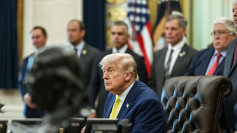
The U.S. Department of Justice argued in federal court this week that President Donald Trump cannot safely perform presidential duties at the White House without a controversial new ballroom and security expansion, escalating a legal and political fight that has already drawn scrutiny from lawmakers and preservation groups.
The filing, submitted by Acting Attorney General Todd Blanche, came days after a gunman opened fire near a Secret Service checkpoint outside the White House complex in Washington, D.C. Authorities said the suspect was killed during the confrontation and a bystander was injured.
Trump administration lawyers directly linked the incident to their argument for restarting construction on the proposed White House ballroom project, which was partially halted earlier this year by a federal judge.
According to the court filing cited by CBS News, Blanche argued that the project is not simply a ceremonial venue or entertainment hall, but part of a broader hardened security system intended to protect the president, senior staff and foreign dignitaries during emergencies.
"The President cannot safely conduct the business of the United States," Blanche wrote in the filing.
The administration said the planned 9,000-square-foot structure would function as a fortified "SAFE HAVEN" connected to the East Wing expansion. Court documents described a facility designed with reinforced steel framing, blast-resistant and ballistic glass, drone-resistant roofing systems and military-grade ventilation protections.
The filing also referenced:
- Bomb shelter capabilities
- Secured operational areas for emergency continuity
- Enhanced counter-drone defenses
- Medical response facilities
- Additional perimeter security infrastructure
The White House legal push follows months of disputes over whether the administration can move forward with the project without explicit congressional authorization.
Earlier this year, a federal district judge temporarily paused major portions of construction after ruling the administration had not fully satisfied oversight and approval requirements tied to modifications of the White House complex. While an appellate court later allowed limited preliminary work to continue through early June, significant restrictions remain in place.
Builders have reportedly continued foundation work and internal structural preparations, but major above-ground construction remains legally constrained while appeals continue.
The Trump administration has repeatedly defended the project as both a modernization effort and a national-security necessity. Trump himself has publicly insisted the ballroom would be financed through private funding rather than taxpayer appropriations, though lawmakers from both parties have continued raising questions about transparency, oversight and long-term operational costs.
Critics argue the administration is using legitimate security concerns to accelerate a politically controversial construction project without adequate congressional review. Preservation advocates have also warned that large-scale structural additions to the White House could set a precedent for future administrations to reshape historically protected government property with limited legislative input.
The legal clash now centers on two competing questions: whether the executive branch can independently authorize a major White House expansion under national-security authority, and whether the administration has sufficiently demonstrated that the ballroom project is genuinely necessary for presidential protection rather than political prestige.
An appellate court is expected to revisit the case in early June as construction crews continue limited work under temporary authorization.