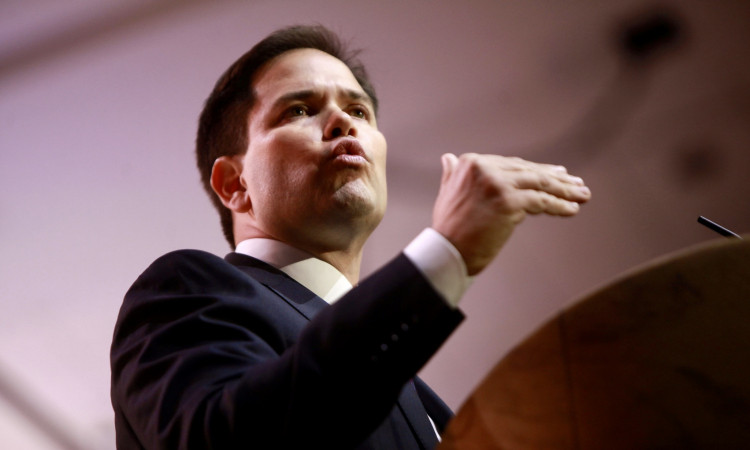
Marco Rubio said negotiations between the United States and Iran could take "a few more days" to finalize after fresh military tensions erupted around the Strait of Hormuz, underscoring the fragile balance between diplomacy and military escalation in one of the world's most strategically important waterways.
Speaking to reporters following renewed security incidents near the Gulf shipping corridor, Rubio signaled that President Donald Trump remains committed to negotiations but warned the administration would not rush into an agreement with Tehran.
"President Trump is either going to make a good deal or no deal," Rubio said, adding that negotiations "may take a little while, I mean, a few more days."
The comments came hours after U.S. Central Command confirmed American forces had conducted operations targeting Iranian military assets during what officials described as an ongoing ceasefire period. According to CENTCOM, the strikes were designed to protect U.S. personnel and preserve maritime security after Iranian activity near the Strait of Hormuz intensified.
"Targets included missile launch sites and Iranian boats attempting to emplace mines. U.S. Central Command continues to defend our forces while using restraint during the ongoing ceasefire," CENTCOM spokesperson Capt. Tim Hawkins said in a statement Monday.
The Strait of Hormuz has become the central pressure point in the conflict because roughly one-fifth of the world's oil and liquefied natural gas shipments move through the narrow channel linking the Persian Gulf to global markets. Concerns about shipping disruptions have already rattled energy markets in Asia and Europe, where analysts warn inventories are tightening rapidly after repeated threats to commercial transit.
Rubio tied the latest military action directly to Washington's broader objective of reopening the shipping lane without restrictions from Tehran. "That needs to be open, unimpeded, without tolls," Rubio said, referring to the Strait of Hormuz. "And obviously that needs to happen immediately as soon as anything's agreed to."
Iranian officials, however, have framed the situation differently, arguing they retain the sovereign right to respond militarily if the United States violates the ceasefire arrangement. The Islamic Revolutionary Guard Corps issued a sharply worded statement distributed through Iranian state-affiliated media warning that retaliation remains on the table.
"The Islamic Revolutionary Guard Corps warns against any violation of the ceasefire by the aggressive US military, and considers its right to reciprocal response to be legitimate and certain," the IRGC statement said.
The Guard Corps also claimed responsibility for downing an American drone and firing on additional aircraft that allegedly entered Iranian airspace, though the statement did not specify when those incidents occurred or provide supporting evidence.
Despite the military friction, diplomatic contacts between Washington and Tehran appear to be continuing behind closed doors. Iranian Foreign Ministry spokesman Esmaeil Baghaei acknowledged that progress had been made but cautioned that major differences remain unresolved.
"There are some issues that we have not yet finalized," Baghaei said.
Baghaei also accused the Trump administration of inconsistency during negotiations, suggesting rapid shifts in public messaging from U.S. officials have complicated efforts to secure a durable agreement.
"The frequent changes in positions and contradictions, which do not really need me to explain and which you can simply observe by looking at tweets issued by U.S. officials, show what situation we are dealing with and under what conditions we must pursue a diplomatic process with such a counterpart," he said.