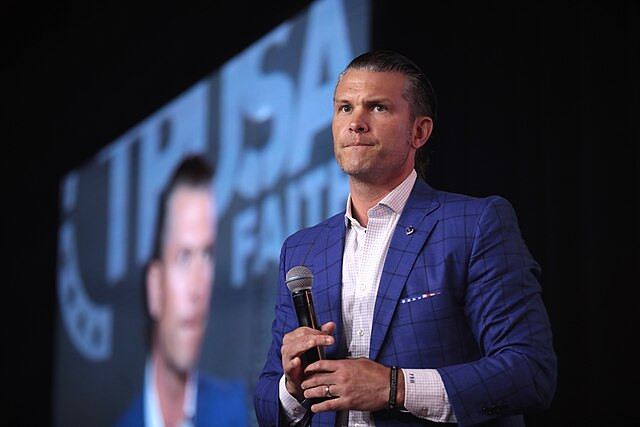
Donald Trump is facing renewed scrutiny over turmoil inside his national security team after Defense Secretary Pete Hegseth abruptly canceled a planned troop deployment to Poland, triggering what The Wall Street Journal described as an angry intervention from the president and setting off a wave of ridicule from late-night television host Jimmy Kimmel.
The controversy erupted after Hegseth reportedly halted a nine-month deployment of roughly 4,000 U.S. troops to Poland, a NATO ally that has become central to Washington's military posture in Eastern Europe. The move came shortly after Trump announced plans to withdraw 5,000 American troops from Germany following criticism from German Chancellor Friedrich Merz over the administration's handling of the Iran conflict.
According to The Wall Street Journal, Trump reacted furiously when informed that Poland had been included in the broader troop reshuffling. The newspaper reported that Trump personally called Hegseth and reversed the decision, later announcing on Truth Social that the United States would not only restore the deployment but expand it to 5,000 troops.
The episode quickly spilled beyond Washington into popular culture, where Kimmel devoted a significant portion of his ABC monologue to mocking the confusion inside the administration.
Kimmel described Hegseth as "a bigger screw-up than Eric" and joked that the defense secretary had attempted to impress Trump by pulling forces from Europe, only to discover that "Poland was not the country he was mad at."
"We've all made mistakes," Kimmel told viewers, before adding, "but only Pete Hegseth can make a 'Donald Trump knows more about Poland than I do' calibre mistake."
The late-night host also mocked reports surrounding Hegseth's alleged drinking habits, which have circulated publicly for months but remain unproven. Framing the issue as a geography lesson for military deployments, Kimmel quipped that troops destined for the Netherlands should be labeled "Heineken," while Germany could be remembered through "Jägermeister."
The ridicule landed at a politically sensitive moment for Hegseth, whose tenure at the Pentagon has already faced criticism from both Democrats and some foreign-policy conservatives uneasy about the administration's rapidly shifting military posture in Europe and the Middle East.
The Poland reversal also highlighted broader tensions within Trump's "America First" strategy. Poland has remained one of Washington's strongest European allies, particularly on defense spending and NATO support, while Germany has increasingly clashed with Trump over Iran policy, energy security and military burden-sharing.
Administration officials have tried to contain speculation that Hegseth's position could be in danger. White House spokesperson Anna Kelly told The Wall Street Journal that "President Trump appreciates all the secretary has done and will continue to do in executing the America First agenda within our military."
Pentagon spokesperson Sean Parnell similarly insisted that Trump and Hegseth remain "in lockstep" regarding U.S. force levels in Europe and emphasized that the two officials "communicate constantly."
Still, the assurances have done little to stop comparisons with previous Trump allies who publicly received presidential praise shortly before being removed from office. Critics online pointed to former Homeland Security Secretary Kristi Noem and former Attorney General Pam Bondi, both of whom were praised by Trump before later losing their positions.
The administration has offered no indication that Hegseth is on the verge of dismissal, and no replacement discussions have been made public. Yet the Poland episode underscored how quickly internal policy disagreements inside Trump's orbit can escalate into public controversies, particularly when military strategy collides with the president's personal frustrations toward foreign leaders.