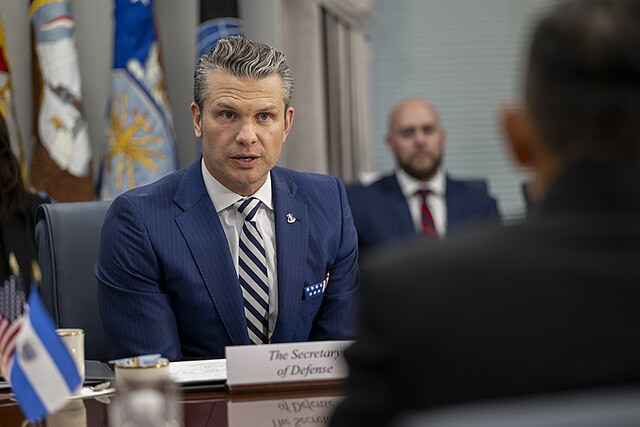
Defense Secretary Pete Hegseth delivered one of the Trump administration's strongest warnings yet to NATO allies on Saturday, telling security leaders at the Shangri-La Dialogue in Singapore that nations unwilling to increase defense spending should expect a "clear shift" in how Washington approaches its alliances.
Speaking before military officials, diplomats and defense ministers from across Asia and Europe, Hegseth framed the administration's message as part of a broader effort to redefine America's global security commitments. The remarks come as President Donald Trump's administration continues pressing both NATO and Indo-Pacific partners to assume a larger share of their own defense responsibilities.
"The era of the United States subsidizing the defense of wealthy nations is over. We need partners, not protectorates. We seek alliances built on shared responsibility, not dependency," Hegseth said, according to an official statement.
The comments underscore a central theme of Trump's second-term foreign policy: that allies benefiting from U.S. military protection should contribute more resources to collective defense. While previous administrations urged allies to boost military spending, Trump officials have increasingly linked future U.S. commitments to whether partners meet those expectations.
At the annual Shangri-La Dialogue in Singapore, Hegseth argued that years of American appeals had failed to produce adequate results from some NATO members. According to AFP, he told attendees: "For too long, polite pleas from our European allies to spend more on their own defense fell on deaf ears."
He added: "They are finally playing catch-up."
The warning comes amid growing debate inside NATO over burden-sharing and the alliance's long-term military posture. Member states agreed in 2025 to pursue defense spending targets equal to 5% of gross domestic product, a substantial increase from previous benchmarks. Yet several governments have signaled that economic pressures could make those commitments difficult to achieve.
Hegseth suggested that failure to meet those obligations could have practical consequences.
"Allies who refuse to step up and carry their own weight for our collective defense will face a clear shift in how we do business," he said.
The speech follows reports that the Pentagon is evaluating reductions in military assets earmarked for Europe during major contingencies. According to reports cited by Bloomberg and other outlets, U.S. officials have discussed scaling back some strategic resources historically available to NATO.
Among the capabilities reportedly under review:
- Strategic bomber deployments
- U.S. Navy destroyer availability
- Submarine resources assigned to alliance missions
Those reports have raised concerns among some European policymakers about whether Washington is gradually reducing its military footprint on the continent. The administration, however, has characterized the effort as a rebalancing rather than a retreat.
While much of Hegseth's speech focused on Europe, he also delivered a message to America's partners in Asia. He argued that regional security has relied too heavily on American military power and warned against allowing national defense capabilities to erode.
At the same time, he praised several Indo-Pacific allies for making substantial defense investments.
"South Korea has invested consistently in its own defense, because it does not have the luxury of treating war like an academic exercise. They live on the front lines, and so they build real combat power," Hegseth said.
He also commended Japan, Australia and the Philippines for strengthening their military capabilities in response to evolving security challenges in the region.
Summarizing the administration's approach, Hegseth delivered a blunt assessment of alliance management: "You don't have a strong alliance unless everyone has skin in the game. No freeloading."
Not everyone within NATO sees the current tensions as evidence of a broader rupture. Admiral Giuseppe Cavo Dragone, the alliance's top military officer, sought to calm concerns during an interview with Bloomberg Television following Hegseth's remarks.
"We don't have any drama going on" with the United States, Dragone said. "I think we are in a good shape."
Dragone also argued that NATO members have already responded to longstanding American demands by significantly increasing military budgets and modernizing their armed forces. His comments reflected a growing view among alliance leaders that while disagreements over spending remain, NATO's core security relationship with Washington remains intact.