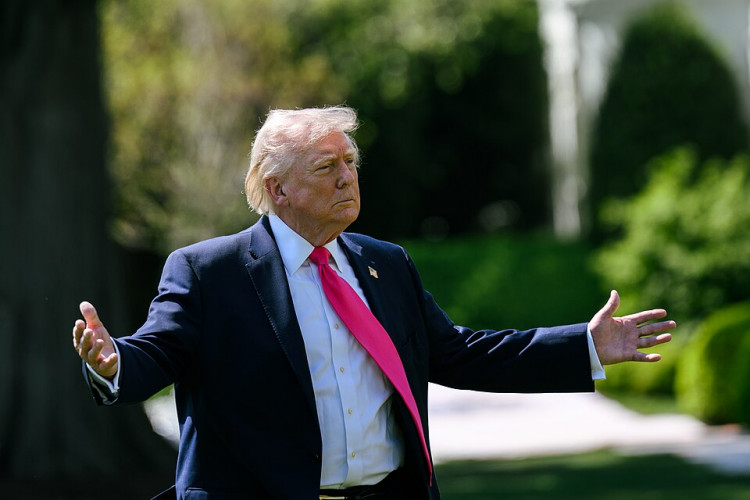
President Donald Trump dismissed reports that Iran has suspended negotiations with the United States, saying Tehran never formally informed Washington of any decision and signaling he is prepared to move forward without further talks as tensions rise across the Middle East.
In an interview with NBC News, Trump responded to reports from Iranian media that negotiations had been halted over Israel's renewed military operations in Lebanon. Rather than expressing concern about the apparent breakdown in diplomacy, the president suggested he was untroubled by the development.
"I think it's fine if they're done talking," Trump told NBC News. "It's an appropriate thing to say, because they're better negotiators than they are fighters."
His remarks come at a delicate moment for U.S.-Iran relations, with ceasefire efforts facing increasing strain and regional violence expanding beyond Gaza into Lebanon and potentially other fronts. The dispute has also raised concerns about shipping routes critical to global energy markets.
Trump said the reported suspension of negotiations would not automatically trigger a broader U.S. military campaign against Iran. However, he indicated that pressure on Tehran would continue through economic and maritime restrictions.
"If they don't want to talk, that's okay with me. I think it's fine. I don't particularly want to talk either. We talk too much," Trump said.
The president added that the situation "doesn't mean we're going to go and start dropping bombs all over there," but reiterated that the United States would maintain its naval blockade of Iranian ports, a measure aimed at restricting Iran's ability to export oil.
The latest diplomatic uncertainty emerged after Iran's Tasnim news agency reported that Tehran had suspended negotiations with Washington in response to Israel's military escalation in Lebanon. According to the report, Iran and allied groups across the region are considering additional measures to increase pressure on Israel and its partners.
Tasnim reported that members of the "Resistance Front," including groups aligned with Iran in Yemen, Lebanon and Iraq, could seek to disrupt traffic through both the Strait of Hormuz and the Bab el-Mandeb Strait. The waterways are among the world's most strategically important maritime corridors, carrying substantial volumes of global oil and commercial shipping.
"The immediate cessation of the Zionist regime's aggressive and brutal army operations in Gaza and Lebanon and the necessity of the regime's complete withdrawal from the occupied areas in Lebanon have been emphasized by Iranian officials and negotiators, and there will be no talks until Iran and the resistance's views on this matter are met," Tasnim said, according to The Times of Israel.
Iran's government has not formally announced a suspension of negotiations. However, Foreign Minister Abbas Araghchi issued a warning linking developments in Lebanon to broader ceasefire arrangements involving Washington and Tehran.
"The ceasefire between Iran and the US is unequivocally a ceasefire on all fronts, including in Lebanon," Araghchi wrote on social media.
"Its violation on one front is a violation of the ceasefire on all fronts. The US and Israel are responsible for the consequences of any violation," he added.
The diplomatic tensions coincided with a renewed Israeli military campaign against Hezbollah targets in Lebanon. After months of attempting to limit operations in Beirut, Israeli leaders signaled a more aggressive posture following continued missile and drone attacks on northern Israeli communities.
"Following the repeated violations of the ceasefire in Lebanon by the Hezbollah terror organization and the attacks against our cities and citizens, Prime Minister Benjamin Netanyahu and Defense Minister Israel Katz instructed the IDF to strike terror targets in the Dahiyeh quarter of Beirut," the officials said in a joint statement.