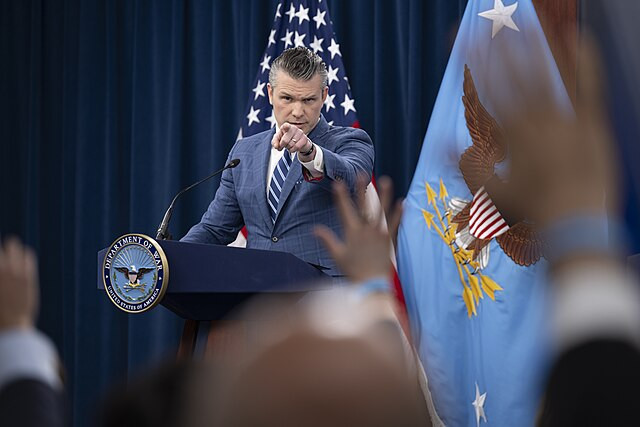
Defense Secretary Pete Hegseth is facing renewed scrutiny over his role in military promotions after reports that he personally intervened to block several Navy officers from advancing to flag rank, a move critics say disproportionately affected women and Black service members and raised questions about the future direction of military leadership under the Trump administration.
According to a report by The New York Times, Hegseth removed at least seven Navy officers from a promotion list for one-star admiral positions. Four current and former defense officials told the newspaper that the intervention bypassed the military's traditional merit-based promotion process and significantly altered the demographic makeup of the final slate.
The revised list reportedly included 22 nominees, none of whom were women and only two of whom were nonwhite. The changes have drawn attention because women account for roughly 21% of the active-duty Navy, while minorities represent about 38% of the service's ranks.
Pentagon chief spokesman Sean Parnell rejected suggestions that race or gender played any role in the decisions.
"Military promotions are given to those who have earned them," Parnell said.
Current and former Navy officials cited by The New York Times said some officers may have been targeted because of past involvement in diversity-related initiatives. One officer reportedly appeared on a website dedicated to identifying so-called "woke" military leaders after serving as a diversity liaison years earlier. The Wall Street Journal reported that eight Navy captains ultimately failed to receive the expected promotions.
The controversy extends beyond the Navy. Earlier this year, Hegseth removed four Army colonels from a promotion list for one-star general positions despite objections from Army Secretary Daniel Driscoll. According to reports, the officers included two women and two Black men.
The broader pattern has alarmed some lawmakers. During a recent congressional hearing, Senator Jack Reed, the ranking Democrat on the Senate Armed Services Committee, argued that women and Black officers have been disproportionately affected by leadership changes carried out under Hegseth.
"You are hollowing out the military's bench of experience and highest-performing senior officers, while making young officers wonder if they should continue to serve," Reed told Hegseth.
Among the most prominent military leaders removed during the administration's leadership shakeup were Charles Q. Brown Jr., the second African American chairman of the Joint Chiefs of Staff, and Lisa Franchetti, the first woman to lead the Navy. While President Donald Trump formally dismissed both officers, Hegseth publicly supported efforts to remove military leaders he viewed as aligned with diversity, equity and inclusion initiatives.
Questions have also emerged about Hegseth's reported support for Navy SEAL Captain William Francis Jr., his special military assistant. According to The New York Times, Francis had previously been passed over by promotion boards and lacked certain command qualifications normally associated with advancement to flag rank.
Representative Chrissy Houlahan challenged Hegseth during a congressional hearing about reports that he sought to place Francis on a promotion list. Hegseth responded, "I'm not aware of what you're referring to." The New York Times later characterized the answer as "at best, misleading."
The debate intensified further after the U.S. Court of Appeals for the District of Columbia Circuit ruled on June 1 that the administration's transgender military service ban was unconstitutional. The court stated that the "Commander-in-Chief declared transgender people as categorically unfit for military service explicitly because of their gender identity."