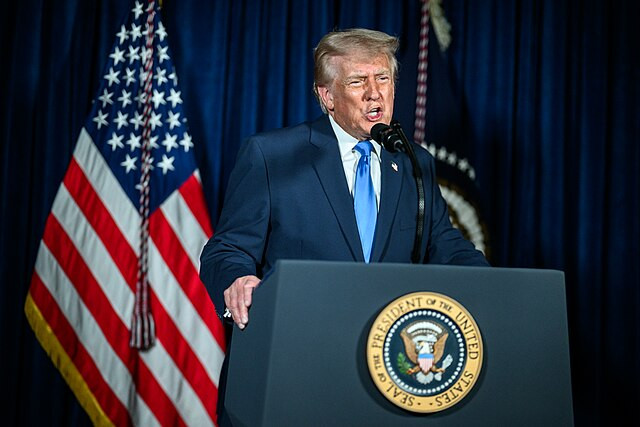
President Donald Trump sharply rebuked lawmakers after the House of Representatives approved a war powers resolution aimed at restricting U.S. military action against Iran, dismissing the measure as "meaningless" and accusing members of his own party of undermining sensitive negotiations with Tehran.
The vote marked the first time since the conflict began that the House successfully passed legislation seeking to limit presidential military authority over operations involving Iran. The development exposed growing divisions within Congress over the administration's handling of Operation Epic Fury and renewed debate about the balance of power between the White House and lawmakers during military conflicts.
Trump responded within hours on social media, directing much of his criticism toward the four Republican representatives who joined Democrats in supporting the resolution.
"Who would do such an unpatriotic thing. They know where the negotiations stand. The Democrats are fueled by Trump Derangement Syndrome. They would rather have our Country fail than give me another, of many, victories. The four Republicans, that's a whole other story - They're GRANDSTANDERS! They should be ashamed of themselves," Trump wrote.
The House approved the measure by a narrow 215-208 margin. Republicans Thomas Massie of Kentucky, Brian Fitzpatrick of Pennsylvania, Tom Barrett of Michigan and Warren Davidson of Ohio broke with party leadership and voted alongside Democrats. The vote also represented the first time Democrats unified behind the proposal after several earlier attempts failed to gain full support within the caucus.
The congressional push gained momentum after the Senate also approved a similar war powers resolution. That vote passed 50-47 after Republican Sen. Bill Cassidy of Louisiana reversed his previous position and joined fellow Republicans Rand Paul, Susan Collins and Lisa Murkowski in backing the measure. Democratic Sen. John Fetterman of Pennsylvania remained the lone Democrat voting against the resolution.
Cassidy cited concerns about congressional oversight in explaining his decision.
"While I support the administration's efforts to dismantle Iran's nuclear program, the White House and Pentagon have left Congress in the dark on Operation Epic Fury," Cassidy said in a social media post. "Until the administration provides clarity, no congressional authorization or extension can be justified."
The legislation would require the administration to remove U.S. forces from hostilities involving Iran unless Congress explicitly authorizes continued military action. The House resolution was introduced in April by Rep. Gregory Meeks of New York, the ranking Democrat on the House Foreign Affairs Committee.
Supporters of the measure argue that Congress has a constitutional responsibility to authorize military engagements and oversee the deployment of American forces abroad. Critics counter that imposing restrictions during active negotiations could weaken the administration's leverage with Tehran and regional actors.
House Foreign Affairs Committee Chairman Brian Mast forcefully opposed the resolution, calling it a "stupid political vote" that "weakens the president's hands as he's negotiating with Iran."
"We're going to continue to do our constitutional responsibilities," Mast said afterward, rejecting accusations that congressional involvement could undermine diplomatic efforts.