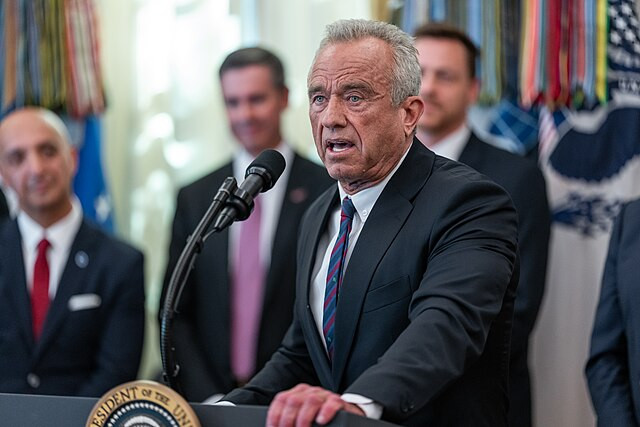
Health and Human Services Secretary Robert F. Kennedy Jr. launched a forceful public rebuttal against The New York Times after the newspaper published a profile portraying him as disengaged from key responsibilities at the Department of Health and Human Services during a period marked by concerns over an Ebola outbreak in Africa.
The dispute has evolved into a broader fight over Kennedy's leadership of one of the federal government's largest agencies, with the secretary accusing the newspaper of pursuing a predetermined narrative while the Times defended a portrait built on interviews with current and former officials familiar with department operations.
The controversy began after veteran New York Times reporter Sheryl Gay Stolberg published a lengthy profile examining Kennedy's management style since taking office. According to the article, Kennedy has focused heavily on priorities associated with his "Make America Healthy Again" agenda, including food policy, pesticide exposure and vaccine-related issues, while showing less interest in the daily administration of the department.
Stolberg wrote that, according to colleagues, Kennedy had remained largely detached from many operational matters inside HHS. "Mr. Kennedy has shown little interest in managing the details of work in his department, according to multiple colleagues," she wrote. "Instead, they say, he is single-mindedly focused on his top priorities, including food recommendations and pesticide exposures, and hunting for evidence to support his long-held beliefs that vaccines are harmful."
The article gained particular attention because of its discussion of Ebola. Critics cited in the report suggested that Kennedy was insufficiently engaged as health officials monitored developments related to the outbreak abroad. The implication that the nation's top health official was detached during a significant public-health challenge quickly became the most politically sensitive element of the story.
Kennedy responded Monday with an 870-word post on X that directly challenged both the reporting and the motivations behind it. The HHS secretary accused Stolberg of relying on disgruntled former employees and constructing a narrative before conducting interviews.
"You had a preconceived thesis, and you set out to prove it," Kennedy wrote. He also described the article as "unfair, inimical, and inaccurate" and argued that many of the sources cited were "anonymous employees, some of whom I fired or who quit to avoid being fired."
Rather than limiting his response to the Ebola allegations, Kennedy sought to highlight what he characterized as management reforms inside the department. "When I took this job, the building was empty. About 90% of the employees were not coming to work. I changed that, but your newspaper never covers my reforms," he wrote.
Kennedy also compared his attendance record to that of his predecessor, adding: "Nor did you cover the fact that my predecessor almost never showed up for work here during his four years in office."
The Times profile included additional claims regarding Kennedy's daily routine, citing unnamed officials who alleged that he often arrived at HHS headquarters around mid-morning, departed for the gym in the afternoon and spent significant portions of the day disconnected from departmental operations. Those assertions were not accompanied by publicly released records documenting his schedule.
The article also examined Kennedy's relationship with career health officials and federal agencies under HHS oversight. Stolberg reported that Kennedy has "remained isolated from much of the department's top staff" while several senior positions remain vacant and veteran scientists have departed.
One example highlighted in the profile involved Kennedy's limited visits to the Centers for Disease Control and Prevention. According to the report, he has made only one publicly known trip to CDC headquarters, a visit that occurred after a gunman fatally shot a police officer near the agency's campus.