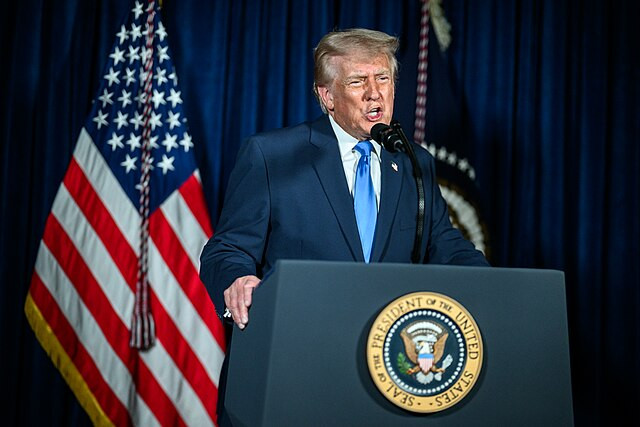
President Donald Trump claimed Wednesday that the United States has been quietly removing "millions of barrels" of Iranian oil during the ongoing confrontation with Tehran, arguing that the undisclosed operation has helped prevent a dramatic spike in global energy prices as military tensions intensify in the Gulf region.
Speaking at the White House, Trump tied the alleged effort directly to oil market stability, suggesting that crude prices would be substantially higher without U.S. intervention. His remarks came as investors weighed the risks of a broader conflict involving Iran, a major energy producer located near the strategically critical Strait of Hormuz.
"Do you know we've been taking out millions of barrels of oil. Nobody knows about it. You know who doesn't know about it? Iran, until right now," Trump told reporters.
The president offered no documentation or operational details to support the claim, leaving analysts uncertain whether he was referring to sanctions enforcement, interdiction efforts, military operations, or another form of pressure campaign against Tehran's oil exports.
Trump went further, arguing that the alleged operation had prevented a severe supply shock in global markets.
According to the president, oil prices could have surged to "$250" per barrel without U.S. actions. Benchmark crude prices, however, remained far below that level despite heightened geopolitical tensions.
Energy markets continued to react cautiously rather than panic. By Wednesday afternoon:
- West Texas Intermediate crude traded near $91 a barrel.
- Brent crude approached $94 a barrel.
- The United States Oil Fund gained roughly 3%.
- Oil-focused leveraged funds posted stronger gains.
The comments followed another escalation in U.S.-Iran tensions. Earlier in the day, Trump warned Iran would "pay the price" after reports that a U.S. Apache helicopter had been shot down near the Strait of Hormuz. Subsequent U.S. strikes against Iranian targets further increased concerns about regional stability and the security of global energy supplies.
Trump also made additional claims regarding military operations, saying the United States had destroyed Iranian radar capabilities and had taken out 22 Iranian ships during overnight actions. No independent confirmation of those assertions was immediately available from the Pentagon, allied governments, or international monitoring organizations.
Beyond energy markets, investors reacted negatively to the growing geopolitical uncertainty. Major U.S. stock indexes moved lower as traders assessed the potential economic consequences of a prolonged confrontation.
The Dow Jones Industrial Average fell more than 700 points at its session low before recovering part of its losses. The S&P 500 declined approximately 0.8%, while the Nasdaq Composite dropped more than 1%.
During his remarks, Trump also signaled that military pressure would continue.
"We'll see what happens, but we hit them hard yesterday, and we're going to hit them again hard today... And we'll see what happens with the deal. We were really close to the deal, but they keep tapping us along," he said.
The president again urged Iran to accept a U.S.-backed agreement regarding its nuclear program.
"They should sign the deal, it's a good deal," Trump said.