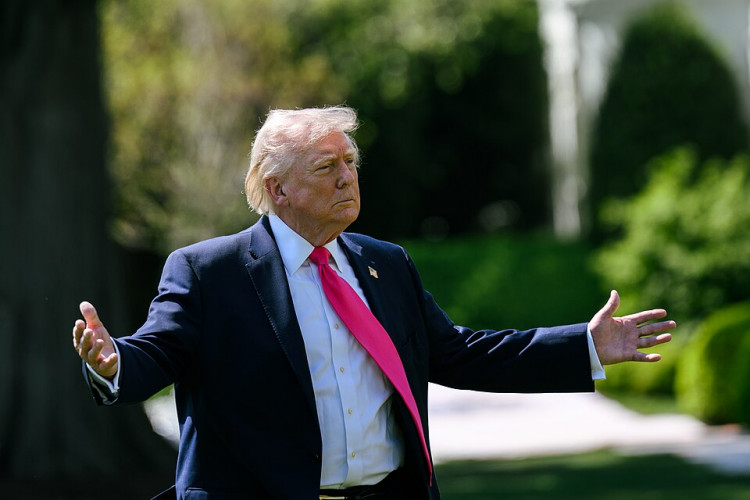
President Donald Trump raised the possibility of a future U.S. operation targeting Cuba, drawing comparisons to the January capture of Venezuelan President Nicolás Maduro and fueling fresh debate over Washington's long-term strategy toward Havana as tensions across multiple regions continue to reshape U.S. foreign policy.
In an interview on The Axios Show, Trump was asked whether a Cuba operation resembling the mission that resulted in Maduro's transfer to New York could occur. His response was brief but notable.
"Possibly. It's possible," Trump said.
The remarks come as the administration intensifies economic and diplomatic pressure on Cuba while simultaneously pursuing negotiations aimed at stabilizing the Middle East. Trump's comments immediately attracted attention because they appeared to leave open the possibility of a more aggressive approach toward the Cuban government, even as administration officials publicly emphasize sanctions and political pressure.
The president has frequently highlighted what he views as renewed American influence throughout the Western Hemisphere during his second term. His latest comments arrived against the backdrop of an unprecedented operation earlier this year in Venezuela, where Maduro was transported to New York to face federal narcotics charges following a rapid U.S. mission that stunned governments across Latin America.
The administration has continued to adjust its Venezuela strategy as well. Last month, the Associated Press reported that federal prosecutors in Miami were instructed not to pursue criminal investigations involving Venezuela's acting President Delcy Rodríguez, a longtime ally of Maduro. That decision came as Washington sought to manage a complex regional landscape following the Venezuelan operation.
Trump suggested geography remains a significant factor in U.S. strategic calculations. Discussing the challenges associated with Iran, he contrasted the Middle Eastern nation with countries closer to American shores.
"These places are close by. Whereas if you look at Iran, that's a very long trip... Venezuela is relatively close and Cuba is a hopscotch," Trump said.
The president also referenced economic considerations when discussing the region.
"Venezuela has oil. Cuba doesn't," Trump added.
In Havana, Trump's comments are likely to reinforce concerns already expressed by Cuban officials. Earlier this month, Cuba's ambassador to the United States, Lianys Torres Rivera, argued that recent sanctions targeting Cuban leadership served as a "pretext" for possible military intervention. Cuban authorities have repeatedly accused Washington of pursuing regime-change policies through economic and diplomatic pressure.
The administration has recently expanded sanctions aimed at key pillars of the Cuban economy. Among the entities targeted is Grupo de Administración Empresarial, known as GAESA, the military-linked conglomerate that controls significant portions of the island's tourism, retail and infrastructure sectors.
Secretary of State Marco Rubio, whose family roots trace to Cuba, has played a central role in shaping the administration's policy. According to administration statements, the sanctions campaign is designed to address what officials describe as national security concerns posed by the Cuban government.
"The sanctions form part of the US administration's comprehensive campaign to address the pressing national security threats posed by Cuban regime," Rubio said.
Additional pressure on Havana emerged in May when Cuban leader Raul Castro was indicted on charges connected to the 1996 downing of two civilian aircraft. According to the indictment, Castro faces allegations including conspiracy to kill U.S. nationals, murder and destruction of aircraft.
Despite Trump's comments, administration policy has largely focused on economic and political measures rather than military action. Axios reported in May that U.S. officials continue to view sustained pressure as the preferred strategy for weakening the Cuban government. At the same time, reports have circulated that some administration officials are monitoring the possibility of political instability in Cuba and assessing scenarios that could emerge if the government faces deeper economic strain.