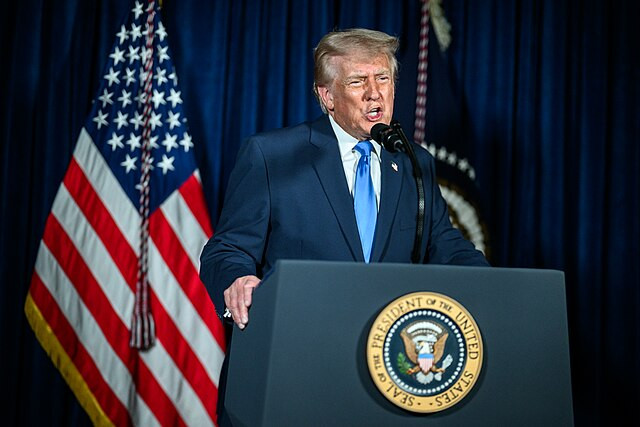
President Donald Trump intensified his campaign to overhaul Senate rules on Monday, declaring that Republicans risk permanent political decline unless they eliminate the legislative filibuster and immediately advance the SAVE America Act, a voting-focused measure that has stalled in the Senate despite clearing the House earlier this year.
In a lengthy Truth Social post, Trump turned one of Washington's most entrenched procedural debates into a direct challenge to fellow Republicans, arguing that the Senate's 60-vote threshold has become an obstacle to his agenda and a threat to the party's future electoral prospects.
"Anybody who doesn't want to terminate the filibuster is a FOOL, a very stupid one, at that!" Trump wrote. He followed with an even more striking warning: "The Republican Party will never win another election. I will, sadly, be the last Republican president."
The comments place renewed attention on the SAVE America Act, legislation that passed the Republican-controlled House in February but has struggled to gain momentum in the Senate. Republicans currently hold a 53-47 majority, leaving them short of the 60 votes generally required to overcome a filibuster and move most major legislation toward final passage.
Trump's latest intervention reflects a broader strategy that has emerged throughout his presidency: treating Senate procedure not as an institutional question but as a political battlefield. Rather than focusing exclusively on persuading Democratic senators to support his priorities, Trump has increasingly argued that Republicans should change the rules themselves.
The filibuster has long occupied a unique place in Senate politics. Although it is not mentioned in the U.S. Constitution, the practice evolved over decades and now serves as one of the chamber's most powerful tools for minority-party influence. In practical terms, it allows senators to block or delay legislation unless supporters can assemble a supermajority.
For Trump, however, the rule has become synonymous with legislative paralysis. In his Truth Social post, he argued that Democrats would eliminate the filibuster if they regained full control of Washington, writing that they would do so "within minutes of taking office" before moving to "rapidly proceed to destroy our country."
No Democratic plan matching that specific description was cited in the material provided, and Trump's assertion remains a political argument rather than an established fact. Nonetheless, it forms the foundation of his case that Republicans should act first rather than preserve a procedural safeguard they may eventually lose.
The president has made similar appeals before. During a government shutdown in late 2025, Trump publicly urged Republican senators to abandon the filibuster as part of an effort to move stalled legislation. At the time, he declared: "We have to get the country open. And the way we're going to do it this afternoon is to terminate the filibuster."
The shutdown ended without any change to Senate rules, underscoring the resistance many lawmakers maintain toward altering procedures that could ultimately benefit whichever party controls the chamber in the future.
That concern remains central to the debate today. Eliminating the filibuster would allow Republicans to advance legislation with a simple majority while they hold power. It would also allow Democrats to do the same whenever control of the Senate changes hands.
Trump's remarks also highlighted how closely he links election policy to broader Republican fortunes. He has repeatedly connected voting legislation, voter identification requirements, mail-ballot restrictions and judicial issues to his push for Senate reform.
"TERMINATE THE FILIBUSTER AND IMMEDIATELY APPROVE THE SAVE AMERICA ACT. GOD BLESS THE U.S.A. President DONALD J. TRUMP," he wrote.
Despite the escalating rhetoric, there was no indication in the source material that Senate Republican leaders were preparing an immediate vote on eliminating the filibuster. No public whip count has emerged showing sufficient support within the GOP conference, and no procedural timetable has been announced.