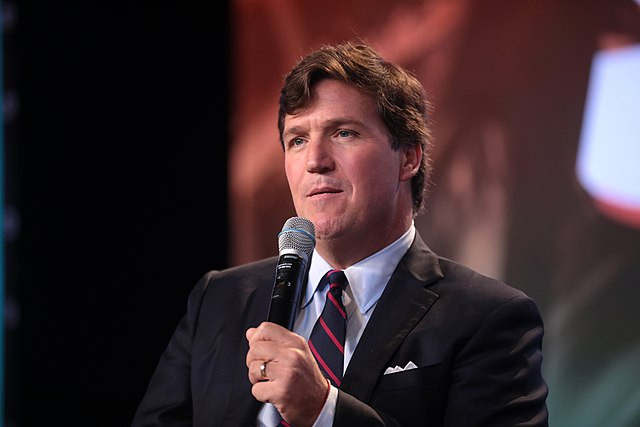
Conservative commentator Tucker Carlson, one of the most influential voices on the American right over the past decade, said he no longer supports the Republican Party, marking a significant break with a political movement he spent much of his career defending.
Speaking on the "Can't Be Censored" podcast, Carlson dismissed the possibility of backing either major political party and suggested he remains undecided about his role in future elections. The comments underscore growing divisions within conservative circles over foreign policy, particularly following the Trump administration's approach to Iran and continued U.S. support for Israel.
"I'm out," Carlson said during the interview.
"I would not support the Republican Party. There's no chance I would support the Republican Party," he added, while also making clear that he does not intend to align himself with Democrats.
The remarks represent a notable shift for Carlson, whose media career has been closely associated with conservative politics. Over more than three decades, he built a national profile through appearances and hosting roles at CNN, MSNBC and later Fox News, where "Tucker Carlson Tonight" became one of the highest-rated programs in cable news before his departure in 2023.
According to NPR, Carlson left Fox News less than a week after the network reached a $787 million settlement with Dominion Voting Systems over broadcasts that promoted false claims regarding the 2020 presidential election. Since then, Carlson has operated largely through independent media platforms, where he has frequently criticized both political parties and the Washington establishment.
During the podcast appearance, Carlson argued that his break with Republicans stems primarily from disagreements over foreign policy priorities. While he has publicly supported President Donald Trump in the past, he has become increasingly vocal in opposing U.S. military involvement abroad and questioning American support for Israel.
Carlson framed the issue not as a disagreement over strategy but as a question of political loyalty and national interest.
"How could I or any American voter support a political party that's not loyal to the United States. That puts the interests of a foreign country above those of its own citizens. It's not possible to vote for people like that, and I'm not going to," Carlson said.
The comments come at a time when foreign policy has emerged as one of the most contentious issues within the Republican coalition. While many traditional Republican lawmakers continue to support strong military alliances and close ties with Israel, a growing populist wing has argued for a more restrained U.S. role overseas.
Carlson has become one of the most prominent voices in that faction. His criticism intensified during debates surrounding the conflict involving Iran, with the commentator repeatedly warning against deeper American military engagement in the region.
During the podcast, he accused political leaders of allowing outside interests to shape decision-making in Washington.
"They are making decisions on the basis of other criteria, what's best for this company, what's best for Israel, what's best for our donors," Carlson said. "That's not just, like, they are off in the wrong direction, like, that is unacceptable, that's treasonous, it's immoral, it can't continue."
The Associated Press noted that Carlson's position highlights a broader ideological struggle inside conservative politics, where disagreements over foreign policy, military intervention and America's role abroad increasingly divide factions that were once united under the Republican banner.