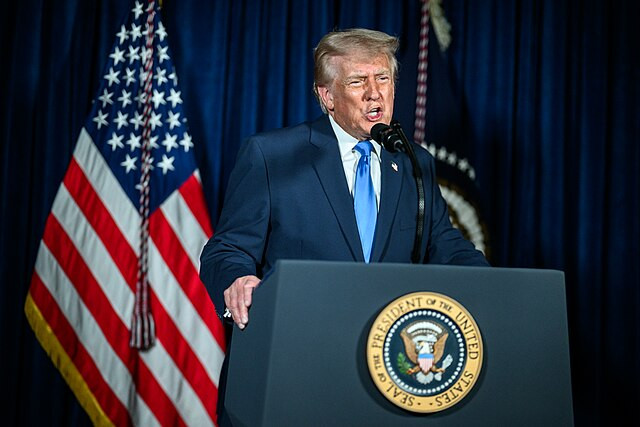
President Donald Trump intensified pressure on U.S. gasoline retailers on Tuesday, warning that companies could face "big problems" if they fail to lower prices at the pump despite declining crude oil costs, as his administration continues to scrutinize the energy industry over what it characterizes as delayed price reductions.
In a post on Truth Social, Trump argued that falling oil prices should already be translating into cheaper gasoline for consumers and accused retailers of keeping prices artificially high. The remarks come as the administration seeks to highlight lower energy costs following easing tensions in the Middle East and renewed efforts to stabilize shipping through the Strait of Hormuz.
"Gasoline Retailers must get their Prices down, IMMEDIATELY! They're too high considering that Oil is now at $68 a Barrel, and heading south," Trump wrote.
He continued: "The Retailers must quickly react to this statement, and do what they know is right - DROP YOUR PRICE FOR OUR GREAT AMERICAN PEOPLE! There will be no gauging, which is totally illegal. If Retailers don't do this, big problems lie ahead! Start targeting around the $2.50 a Gallon number, and California should stop charging such heavy Taxes on their Gasoline. Soon the Tax will be higher than the Product itself, and the United States will not stand for it, nor will the People of California, who are being abused by these ridiculous Taxes, and by their own Government."
Trump's comments came even as oil markets showed renewed volatility. On Tuesday morning, West Texas Intermediate crude traded above $71 a barrel after rebounding from recent declines, illustrating the continued uncertainty surrounding global energy markets despite the ceasefire agreement between the United States and Iran.
The administration has repeatedly argued that reduced geopolitical risk should lead to lower fuel prices for American motorists. Following the agreement between Washington and Tehran to halt hostilities and work toward reopening commercial traffic through the Strait of Hormuz, Trump publicly urged companies throughout the fuel supply chain to pass lower costs on to consumers.
Last week, the president expanded that campaign by accusing major oil companies of overcharging motorists and directing federal authorities to examine industry pricing practices.
"The big Oil Companies are not dropping their price at the pump commensurate with the sharply lower prices they are paying for Oil," Trump wrote in an earlier social media post. "Customers are being gouged," Trump added, claiming that he had instructed the Department of Justice to "immediately start looking into this."
The industry, however, says the relationship between crude oil prices and retail gasoline prices is not immediate.
Chevron Chief Financial Officer Eimear Bonner said last week that consumers should expect prices to decline gradually rather than instantly because of the mechanics of fuel distribution and inventory management.
Speaking on CNBC's Squawk Box Europe, Bonner said companies are doing "everything we can" to address the situation.
"What I would say is, we're all concerned about prices. So, there is a lot of empathy, whether it's in the U.S. or here in the U.K. or in Europe for consumers," Bonner said.
She added, "It's going to take time though. There is a lag between, you know, oil prices and reductions in oil prices and when that shows up at the pump, but we expect that prices will come down as things continue to normalize."
Energy analysts have long noted that retail gasoline prices typically move more slowly than crude oil markets because wholesalers and retailers often continue selling fuel purchased weeks earlier at higher wholesale prices. Distribution costs, refining margins, transportation expenses and regional tax structures also influence pump prices independently of crude benchmarks.
California remains a particular focus of Trump's criticism because the state consistently posts some of the nation's highest gasoline prices, reflecting a combination of fuel taxes, environmental regulations, specialized fuel requirements and transportation costs.