President Donald Trump has privately discussed the possibility of renewed military action against Iran with his top national security advisers, even as his administration continues indirect negotiations with Tehran aimed at securing a nuclear agreement and preserving a fragile ceasefire reached after recent fighting in the Strait of Hormuz.
The parallel diplomatic and military tracks illustrate the administration's dual strategy toward Iran. While senior U.S. officials continue negotiations through regional mediators in Qatar, Trump has reportedly instructed advisers to prepare for multiple scenarios should diplomacy fail or Iran violate the ceasefire, according to people familiar with internal discussions.
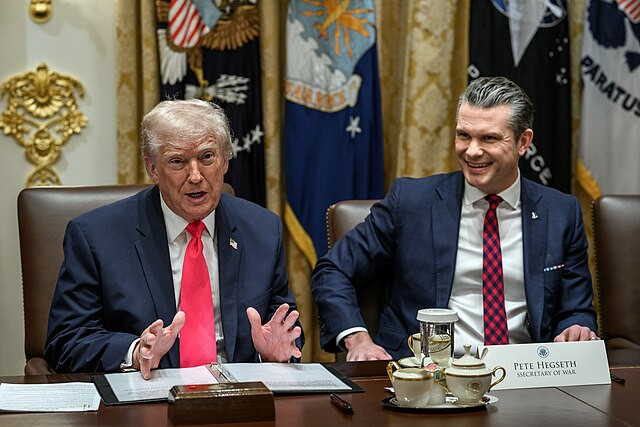
According to The Wall Street Journal, Trump has held multiple meetings with Defense Secretary Pete Hegseth and Chairman of the Joint Chiefs of Staff Gen. Dan Caine to evaluate military options, including the possibility of renewed strikes against Iranian targets.
Officials familiar with those conversations told the newspaper that the president has nevertheless chosen, for now, to prioritize diplomacy. According to the report, Trump believes another broad military campaign could undermine Washington's effort to prevent Iran from advancing its nuclear program. While remaining open to targeted military action in response to future ceasefire violations, he has reportedly concluded that continued negotiations currently offer the better path forward.
The president has also shown flexibility regarding the timeline for negotiations.
According to The Wall Street Journal, Trump has told advisers he would accept talks extending beyond the Aug. 18 deadline he previously established for reaching a nuclear agreement if negotiations continue making meaningful progress.
Vice President JD Vance publicly reinforced that approach during an interview with Fox News on Tuesday.
"What the president has told us is, work the problem, see where the negotiation is going to lead. And if it doesn't lead to a successful resolution on the diplomatic side, we still have a lot of optionality, and we still accomplished a whole lot for the American people," Vance said.
While Washington weighs its next steps, diplomatic contacts between the two countries have continued through intermediaries.
Indirect negotiations resumed this week in Doha under the mediation of Qatari and Pakistani officials. According to CBS News, citing a source with direct knowledge of the discussions, U.S. envoys Steve Witkoff and Jared Kushner met Tuesday with Qatari Prime Minister Sheikh Mohammed bin Abdulrahman Al-Thani but are not participating in the technical talks scheduled for Wednesday.
The negotiating agenda has extended beyond nuclear issues.
An Iranian official told Reuters that current discussions are focused on two major issues:
- The future release of Iranian assets frozen abroad.
- Security arrangements involving the Strait of Hormuz.
Those issues have become increasingly intertwined following the recent ceasefire, which ended direct military exchanges between the United States and Iran after attacks around one of the world's most strategically important shipping lanes.
Iranian officials have publicly claimed that negotiations are already producing economic benefits.
President Masoud Pezeshkian announced Monday that Qatar had agreed to release $6 billion of Iranian funds held overseas.
"Based on the plans made, $6 billion out of the total $12 billion of Iranian resources in Qatar will be released and returned to the country, and necessary follow-ups are being carried out," Pezeshkian said in remarks published by the state-run IRNA news agency. He described the broader understanding reached with the United States as "a great victory for the Iranian people."
Washington has disputed that account.
According to The Associated Press, U.S. officials said no frozen Iranian assets have been released, while Qatari authorities have not acknowledged any transfer of funds. The differing public statements underscore the continuing disagreements surrounding implementation of the ceasefire and the broader negotiations.
Military planning has reportedly continued inside the Pentagon even as negotiators pursue a diplomatic resolution. Officials familiar with the discussions told The Wall Street Journal that Trump remains prepared to authorize limited military action if Iran commits actions Washington considers serious violations of the ceasefire, but the White House has so far resisted returning to a wider conflict.