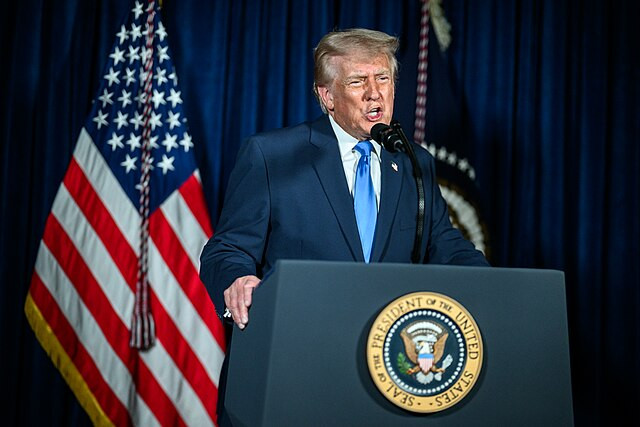
President Donald Trump was secretly moved out of Turkey aboard a smaller military aircraft after U.S. officials received intelligence indicating Iran knew unusually precise details about his location in Ankara and might attempt to target his plane with shoulder-fired missiles, according to reports about an extraordinary presidential security operation.
The threat emerged July 8 during the final day of a NATO summit in Ankara, when U.S. officials received multiple streams of intelligence concerning a potential Iranian operation against Trump. Among the most alarming information was an indication that Tehran knew where the president was staying-and reportedly the specific floor of the building.
Security officials were also evaluating intelligence about a possible attack on Trump's aircraft using shoulder-fired surface-to-air missiles. The precise intelligence underlying those assessments hasn't been publicly released, but officials considered the information serious enough to substantially alter the president's departure from Turkey.
What followed turned the familiar image of Air Force One into part of a deception operation. Trump publicly boarded the older presidential Boeing 747 in front of television cameras, creating the appearance that he would travel aboard the aircraft to Britain.
Trump had said he wanted to use the older jet "for old time's sake." The administration's public explanation for the change was that the newer Qatari-donated Boeing 747-8 was being sent ahead to Britain so American military personnel could tour it.
Trump didn't make the flight from Turkey to Britain aboard the plane he was seen boarding, according to subsequent reporting. Instead, the president and a small number of aides were quietly removed from the Boeing 747 from the side of the aircraft shielded from public view.
An airport catering truck was raised to a service door, allowing Trump to leave the plane without crossing the visible tarmac. He was then transported to a C-32A, the U.S. Air Force's military version of the Boeing 757, which departed separately for Britain.
The larger Boeing 747, meanwhile, continued its own journey carrying journalists and White House personnel who believed Trump remained aboard. Secretary of State Marco Rubio was among the senior officials reportedly traveling on that aircraft.
That arrangement allowed the highly recognizable presidential jet to continue appearing to be Trump's aircraft while the president traveled aboard a substantially less conspicuous plane. The available reporting, however, doesn't establish that passengers aboard the larger aircraft were intentionally used as human decoys or knowingly exposed to an identified attack.
The deception apparently continued after the aircraft reached RAF Mildenhall in England. Trump's C-32A arrived separately, after which the president was transferred back to the larger presidential aircraft before appearing publicly, according to reports describing the operation.
The maneuver obscured which plane had actually carried the president out of Turkey and helped maintain the appearance that Trump's travel arrangements had changed little beyond the previously announced aircraft swap.
Trump later confirmed that his security team had directed him to use a different aircraft, though he didn't publicly describe the intelligence that prompted the decision.
"I go by Secret Service and the military," Trump said. "They wanted me to go on a different flight, a different plane. I do what they say."
The operation took place amid heightened military tensions between the U.S. and Iran. Trump had already spoken publicly about threats from Tehran, and subsequent reporting indicated that Israeli intelligence had provided information concerning a possible Iranian attempt to attack the president's aircraft with shoulder-fired missiles.
The reported knowledge of Trump's location in Ankara adds a potentially more serious dimension to the episode. Knowing the president's hotel would represent one level of surveillance; identifying the floor on which he was staying would suggest considerably more precise intelligence about his movements, assuming the reports accurately reflect what U.S. officials received.
Still, significant details remain classified or otherwise undisclosed. U.S. authorities haven't publicly released evidence showing how Iran allegedly obtained information about Trump's accommodations, whether a specific attack team was identified, where a missile strike might have been attempted or how imminent officials believed the threat was.