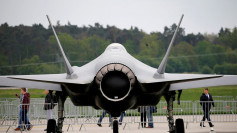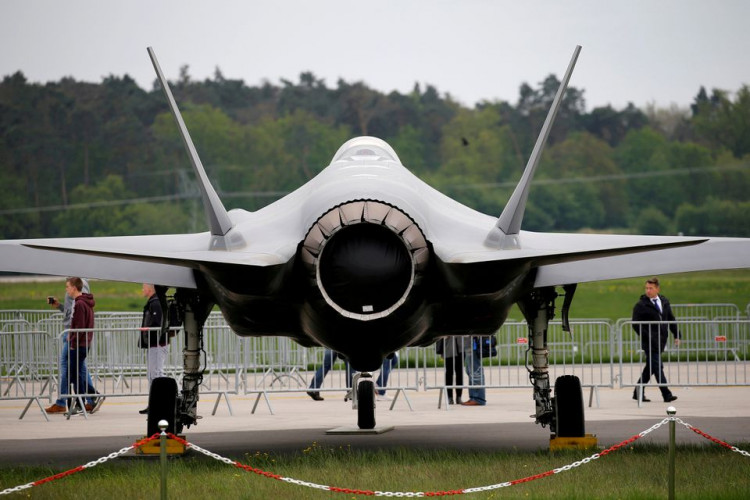
China has taken possession of potentially sensitive components from an F-35 stealth fighter after a UPS shipment was inexplicably diverted to Hong Kong, according to reports, raising questions about whether radar-absorbing technology used on one of America's most advanced combat aircraft could be examined by Beijing.
The shipment included a cockpit canopy and a weapons-bay door from an Australian military F-35 that were being sent to the United States in late May for inspection and possible repair or disposal, according to Bloomberg. Both Lockheed Martin-supplied components were coated with radar-absorbing material designed to improve the aircraft's stealth capabilities.
UPS was transporting the parts when the shipment stopped in South Korea and was subsequently routed to Hong Kong, according to people briefed on the incident. The reason for the stop and subsequent diversion remains unclear, as does whether the routing was accidental or deliberate.
The Chinese government later took possession of the components and had not returned them as of Wednesday, Bloomberg reported, citing people familiar with the matter. That disclosure goes beyond earlier reports, which had established that the shipment was missing in Hong Kong but had not confirmed who ultimately obtained it.
The Pentagon has confirmed that an F-35 shipment problem occurred. Its F-35 Joint Program Office said it was "aware of a shipment issue of unserviceable F-35 Lightning II components," while U.S. and industry officials have been working to retrieve the material.
"We are actively working with U.S. authorities and industry partners to retrieve these components, investigate the incident, and place safeguards to avoid a future occurrence," a Defense Department spokesperson told CNN.
Australian Defense Minister Richard Marles also confirmed Canberra was assisting with the investigation. "We've been made aware of this, and we're obviously working with the United States and Lockheed in terms of how we can assist in this investigation," he said.
Marles has sought to play down concerns that highly classified technology was exposed, saying his understanding was that the missing equipment was not considered sensitive. "We're not talking about sensitive equipment here or sensitive parts," he said.
That assessment contrasts with concerns surrounding the radar-absorbing coatings on the canopy and weapons-bay door. The materials form part of the F-35's low-observable design, which helps reduce the aircraft's radar signature, and reports have raised the possibility that access to the components could give China an opportunity to study aspects of the technology.
There is no public evidence so far that China has successfully reverse-engineered the coatings or extracted useful technical information from the parts. The central security concern is the possibility that physical access could allow engineers to analyze materials or construction techniques that are ordinarily restricted to the U.S. and participating F-35 partners.
Lockheed Martin has declined to discuss individual shipments or its logistics procedures, citing security considerations. The company manages the F-35's global supply chain, while countries participating in the program share inventories and maintenance responsibilities across multiple regions.
Australia operates 72 F-35s and is one of several countries outside the United States participating in a global spare-parts pool. The aircraft is also flown or being acquired by a growing group of U.S. allies, making the supply chain an increasingly complex international network.
Lockheed describes the fifth-generation F-35 as "the most lethal, survivable, and connected fighter aircraft for America and its allies," saying it is designed to integrate operations across air, land, sea, space and cyber domains.
The company also calls the aircraft "a force multiplier," emphasizing its ability to gather, process and distribute battlefield information to other forces.
U.S. officials and lawmakers have been briefed on the missing shipment, according to reports, while the Pentagon, Australia and Lockheed continue examining how the components left their intended route and ended up in Hong Kong. The parts had originally been removed from an Australian F-35 because they were unserviceable and were being sent to the U.S. for evaluation.